


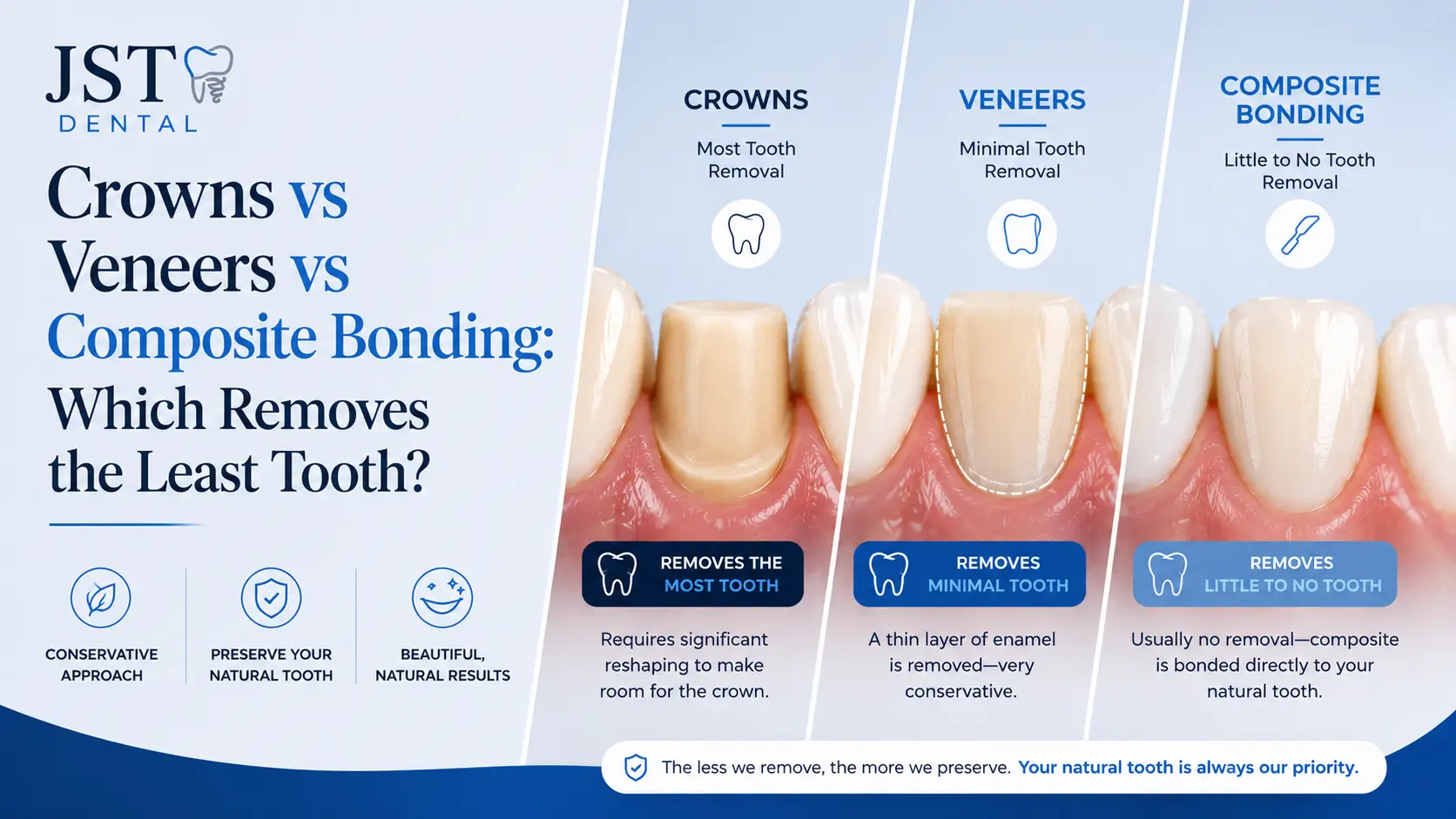
Crowns vs Veneers vs Composite Bonding: Which Removes the Least Tooth?
QUICK ANSWER
Of the three, composite bonding usually removes the least tooth — often little or none — and is reversible. Veneers remove a thin layer of enamel from the front of the tooth. Crowns remove the most, reducing the tooth on every side. As a rule, the least invasive option that achieves your goal is the best one for the long-term health of your teeth, so a conservative clinic will start with bonding or minimal-prep veneers wherever they’ll give you the result you want.
KEY TAKEAWAYS
• Composite bonding — least tooth removed, reversible, lower cost, shorter lifespan.
• Veneers — a thin layer of enamel removed; durable and stain-resistant.
• Crowns — most tooth removed, on all sides; best reserved for damaged or weak teeth.
• Choose the least invasive option that achieves the result — not the most aggressive.
If you want to improve your smile, you usually have three main options: composite bonding, veneers or crowns. They can produce similar-looking results, but they are very different in one crucial respect — how much of your natural tooth they remove. That single factor affects the long-term health of your teeth more than almost anything else, so it’s worth understanding before you decide.
Which removes the least tooth: crowns, veneers or composite bonding?
Composite bonding removes the least — often little or none — followed by veneers, which remove a thin layer of enamel; crowns remove the most, reducing the tooth on all sides.
That ranking is the heart of the decision. If two options would give you a similar result, the one that conserves more of your natural tooth is almost always the better long-term choice.
What is composite bonding, and how much tooth does it remove?
Composite bonding applies a tooth-coloured resin directly to the tooth, usually removing little or no enamel, and it is reversible.
Bonding is shaped and polished by the dentist in a single visit, with no laboratory stage. Because it preserves the tooth and can be removed or repaired, it is the most conservative of the three. The trade-off is that it doesn’t last as long as porcelain and can stain or chip over time. We cover it in depth in our guide to composite bonding.
What are veneers, and how much tooth do they remove?
Veneers are thin porcelain or composite facings bonded to the front of the tooth, typically removing only a small amount of enamel — around 0.3 to 0.7 mm for traditional veneers, and less for minimal-prep options.
Veneers are more durable and stain-resistant than bonding and give a very natural result with quality materials. Because a little enamel is removed, traditional veneers aren’t fully reversible — which is why the amount of preparation matters, as we explain in how much tooth is removed for veneers.
What are crowns, and why do they remove the most tooth?
A crown caps the entire tooth, so it removes substantially more structure from every side — which is why crowns are best reserved for teeth that are damaged, heavily filled or root-treated, rather than healthy ones.
Crowns are strong and long-lasting and are the right answer when a tooth genuinely needs full coverage. The problem arises only when healthy teeth are crowned purely for appearance — often the root of “Turkey teeth” complaints — when a more conservative option would have done the job.
Crowns vs veneers vs composite bonding: a side-by-side comparison
Bonding conserves the most tooth and is reversible but least durable; veneers balance conservation and durability; crowns are the most durable but remove the most tooth.
- Tooth removed — Bonding: minimal/none · Veneers: thin enamel layer · Crowns: most, all around.
- Reversible — Bonding: largely yes · Veneers: not fully · Crowns: no.
- Durability — Bonding: shorter · Veneers: long · Crowns: longest.
- Best for — Bonding: small chips, gaps, minor reshaping · Veneers: cosmetic changes to mostly healthy teeth · Crowns: damaged, weak or root-treated teeth.
- Typical cost — Bonding: lowest · Veneers: mid · Crowns: similar to veneers, varies by case.
Which option is right for you?
The right option is the least invasive one that achieves your goal — which depends on the condition of your teeth, what you want to change, and your budget, and is best confirmed by an assessment.
Someone with small chips or gaps may only need bonding; someone wanting a lasting cosmetic change to healthy teeth may prefer veneers; someone with a weak or root-treated tooth may genuinely need a crown. A careful clinic recommends based on your teeth, not a fixed package.
How we choose the most conservative option at Just Smile
At Just Smile we recommend the least invasive treatment that will achieve your goal — starting with bonding or minimal-prep veneers wherever suitable — with treatment led by Dr Niyazi Ediboğlu (43+ years).
After a free online assessment and an in-person examination, you receive a written plan that states the recommended option for each tooth and why. Where a smaller treatment will serve you just as well, that’s what we’ll suggest. We won’t promise a specific result — individual results vary — but we will always explain the trade-offs honestly.
Frequently asked questions
Which is better, veneers or crowns?
Neither is universally better — veneers conserve more tooth and suit cosmetic changes to healthy teeth, while crowns suit damaged or weak teeth that need full coverage.
Is composite bonding cheaper than veneers?
Usually yes, and it removes less tooth, but it doesn’t last as long and can stain or chip over time.
Can I switch from bonding to veneers later?
Often yes, because bonding is conservative — which is one reason it’s a sensible starting point for many people.
Do crowns ruin healthy teeth?
Crowning a healthy tooth purely for looks removes a lot of structure unnecessarily; crowns are best kept for teeth that genuinely need full coverage.
Which lasts the longest?
Crowns and veneers generally last longer than bonding, though all depend on the material, your bite and how you care for them.
Not sure which option you actually need?
Send a few photos for a free online consultation and we’ll recommend the least invasive option for your teeth — in writing, with no obligation.