

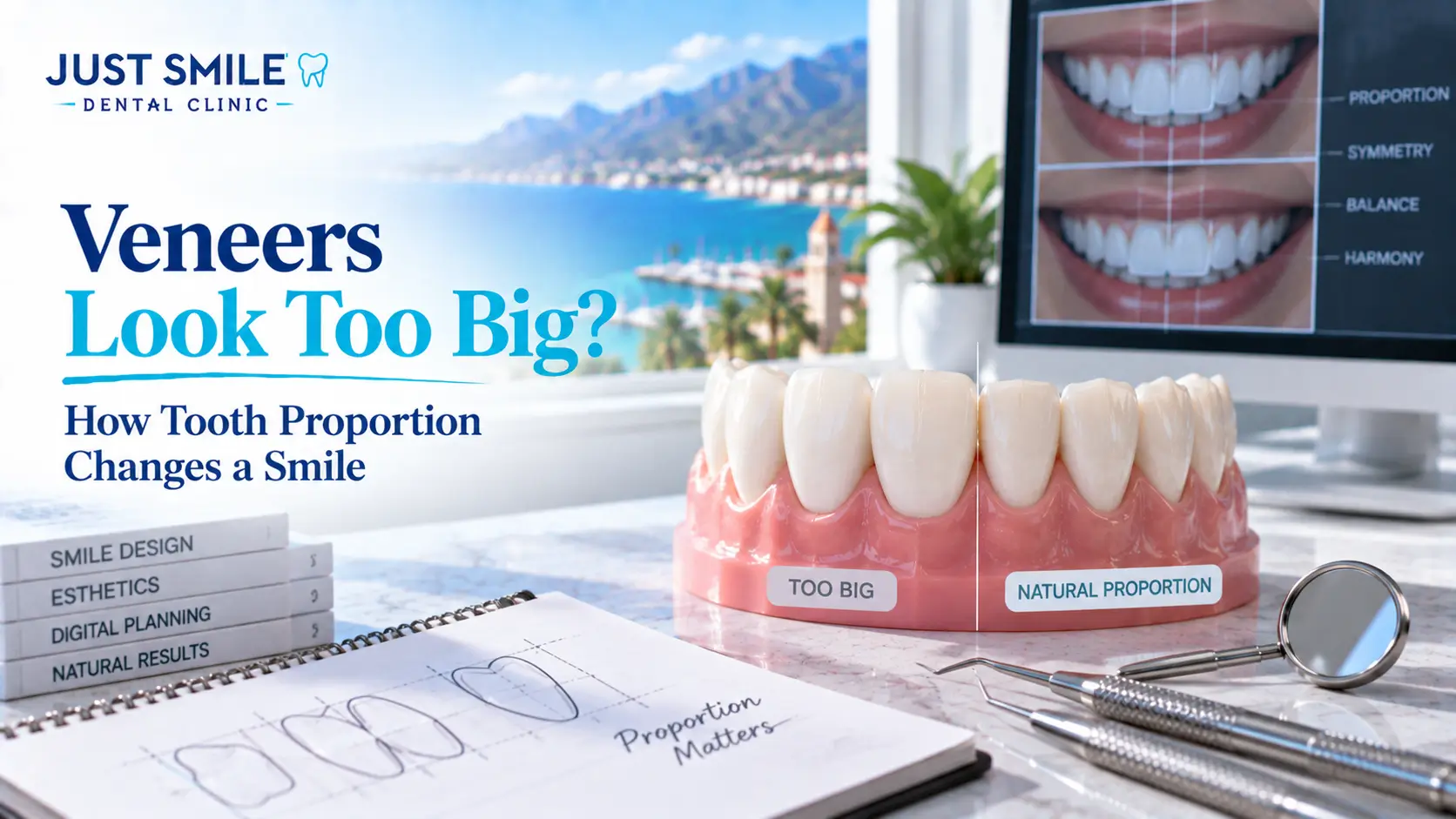
Veneers Look Too Big? How Tooth Proportion Changes a Smile
Quick Answer
If your veneers look too big, the problem may not simply be that the teeth are too long.
Veneers can appear oversized when they are too wide, too bulky, too uniform, too prominent near the gums or out of proportion with the lips and neighbouring teeth. Even the shade and surface texture can make teeth appear visually larger.
At JST Dental, veneer size is therefore considered as part of the complete smile rather than by measuring each tooth in isolation.
What Does “Veneers Look Too Big” Actually Mean?
People often use the word “big” to describe several different visual problems.
They may mean:
- The teeth look too long.
- The teeth look too wide.
- The front surface looks bulky.
- The smile feels too dominant.
- Too much tooth shows when smiling.
- The front teeth look like one solid block.
- The veneers project too far forward.
- The proportions do not fit the face.
These are very different design issues.
Reducing tooth length will not necessarily solve a veneer that looks too wide.
Making a veneer narrower will not correct excessive facial bulk.
The first step is therefore identifying what is creating the impression of size.
Tooth Length Is Only One Part of the Problem
Front tooth length has a strong influence on the smile.
Central incisors usually have visual dominance in the middle of the smile. If they are made significantly longer than the surrounding teeth or than the lips can comfortably frame, they may begin to dominate the face.
But short teeth are not automatically better.
Reducing the central incisors too much can flatten the smile and remove the natural difference between central and lateral incisors.
This is why veneer length needs to work with:
- Smile arc.
- Lip position.
- Existing tooth display.
- Facial proportions.
- Neighbouring teeth.
- Bite.
The correct length is therefore not a standard number that can be applied to everyone.
Width Can Make Veneers Look Even Bigger Than Length
A front tooth can have an acceptable length and still appear oversized if it is too wide.
Width becomes especially important when several veneers are placed next to each other.
If the central incisors, lateral incisors and canines are all designed too broadly, the smile can begin to look crowded and heavy.
The front teeth may also lose their individual identities.
Instead of seeing:
central incisor → lateral incisor → canine
the eye begins to see:
large white tooth → large white tooth → large white tooth.
This is one reason tooth proportions need to be evaluated across the complete smile rather than one veneer at a time.
The Width-to-Length Ratio Changes How a Tooth Looks
Two teeth can have exactly the same length but appear completely different if their widths are different.
A relatively wide tooth can appear:
- Shorter.
- Squarer.
- Heavier.
- More dominant.
A relatively narrow tooth can appear:
- Longer.
- More delicate.
- More vertical.
Dentists use width-to-length relationships as one reference when designing anterior teeth.
However, there is no single percentage that creates the perfect tooth for every face.
Natural teeth vary considerably, which is why mathematical rules should be used as guides rather than templates.
Why Veneers Can Look Bulky
Sometimes “too big” actually means too thick.
A veneer sits on the front surface of the natural tooth.
The final position of the ceramic therefore depends on:
- Where the original tooth begins.
- How much space is available.
- Whether any enamel preparation is appropriate.
- How thick the final ceramic needs to be.
- Where the finished facial surface should sit.
If too much material is added without enough space, the tooth can project forward.
This can make veneers appear bulky even if their length and width measurements look reasonable on paper.
The lips may also sit differently over overly prominent teeth, making the change more noticeable from the side.
Why Very White Veneers Can Appear Larger
Colour can create an optical illusion.
Bright objects attract attention.
A very bright, highly opaque veneer may therefore appear visually larger than a tooth with more natural depth and translucency.
This becomes particularly noticeable when the veneers are:
- Much brighter than the lower teeth.
- Very uniform.
- Highly reflective.
- Opaque from gum line to edge.
- Combined with minimal surface texture.
The actual dimensions may be acceptable.
But the teeth still feel visually dominant.
This is why shade, translucency and tooth size cannot be planned completely independently.
Surface Texture Can Change Perceived Size
Natural enamel contains subtle surface detail.
These variations break up reflections.
If veneers are extremely smooth and glossy, light can reflect strongly across a large uninterrupted surface.
That can make the teeth appear:
- Flatter.
- Brighter.
- Broader.
- More artificial.
Controlled surface texture can help light behave more naturally across the ceramic.
The objective is not to make veneers visibly rough.
The texture should be subtle enough that most people never consciously notice it.
Its effect is mainly seen in how the tooth interacts with light.
Line Angles Can Make a Tooth Look Wider or Narrower
One of the more interesting parts of cosmetic dental design is that the apparent width of a tooth can be changed without dramatically changing its physical width.
This is partly achieved through line angles.
Line angles are the transitions between the visible front surface and the sides of the tooth.
When these visual boundaries move outward, more of the front surface appears visible.
The tooth can look wider.
When they are positioned slightly further inward, the visible front surface becomes narrower.
The tooth can appear slimmer.
This is why simply measuring a veneer with a ruler does not fully explain whether it will look too large.
Visual anatomy matters too.
Why Every Tooth Should Not Have the Same Proportions
Natural central incisors, lateral incisors and canines are different teeth.
They should not simply be scaled copies of one design.
Central incisors normally provide strong visual focus.
Lateral incisors are often smaller and can have softer contours.
Canines help transition the smile toward the side of the dental arch.
If the same width, length and corner design are repeated across all of them, the smile may feel oversized even if no individual veneer is dramatically too large.
The problem is not always size.
Sometimes it is repetition.
Your Lips Help Determine Whether Veneers Look Too Big
Teeth are always seen inside a moving frame: the lips.
The same veneer dimensions can look completely different on two people because they show different amounts of tooth.
One person may naturally reveal a large amount of the upper teeth while smiling.
Another may show considerably less.
Lip movement also changes while:
- Speaking.
- Laughing.
- Smiling lightly.
- Smiling broadly.
This is why close-up photographs of teeth alone cannot determine the best veneer proportions.
The face and lip movement need to be part of the design.
What About the Smile Arc?
The smile arc is the relationship between the edges of the upper front teeth and the curve of the lower lip.
It matters when discussing veneer size because central incisor length contributes strongly to this curve.
If central veneers are excessively long, they can dominate the smile.
If they are shortened too aggressively to make them appear smaller, the smile arc may become flat.
The objective is therefore not simply:
“Make the teeth smaller.”
It is:
“Correct the specific proportion that is creating the problem while preserving the balance of the smile.”
Can Large Veneers Affect the Gum Area?
The contour close to the gums is particularly important.
A veneer that becomes too prominent near the gum line can create a bulky transition between the tooth and surrounding tissue.
From an aesthetic perspective, this may make the tooth appear as though it is sitting on top of the gum rather than emerging naturally from it.
The cervical contour — the shape of the tooth close to the gum — therefore needs careful control.
Healthy gum tissue also needs to be considered before the final shapes are approved.
Can Veneers Be Too Small?
Yes.
Trying too hard to avoid large-looking veneers can create the opposite problem.
Teeth that are too narrow or too short may:
- Leave excessive spaces.
- Look weak within the face.
- Create unusual proportions.
- Flatten the smile arc.
- Lose central incisor dominance.
The objective is not the smallest possible veneer.
It is the appropriate proportion.
Why Digital Smile Design Helps
Digital planning can help compare possible:
- Tooth lengths.
- Tooth widths.
- Smile symmetry.
- Edge positions.
- Overall proportions.
This allows the dental team to identify whether one proposed shape is likely to dominate the smile before the final ceramic is completed.
But digital design should be used as a planning tool rather than an automatic template.
Software can calculate proportions.
It cannot independently decide whether those proportions suit a person’s face, lip movement and natural tooth character.
Clinical judgement remains necessary.
Temporary Veneers Can Reveal Problems That a Screen Cannot
A digital preview is useful.
Seeing provisional shapes in the mouth can provide another type of information.
Temporary restorations can help assess:
- Whether the central teeth feel too long.
- Whether the smile looks too wide.
- Whether tooth display feels excessive.
- How the shapes work with the lips.
- Speech.
- Bite.
- General facial balance.
A design that looks attractive on a monitor may feel different once it is physically present inside the smile.
That is why approval should not focus only on a static digital image.
How JST Evaluates Veneer Proportions
At JST Dental, the question is not simply whether the veneers fit on the teeth.
The design should also fit the complete smile.
Useful questions include:
Are the central incisors too dominant?
Are the lateral incisors sufficiently distinct?
Do the canines transition naturally toward the side of the smile?
Does the width of the teeth suit their length?
Are the veneers projecting too far forward?
Does the smile work with the lips?
Has excessive symmetry made the teeth feel larger than they actually are?
Does the design still look natural during normal conversation?
These questions help separate a measurement problem from a design problem.
Frequently Asked Questions
Why do my veneers look too big?
Veneers may appear too big because of excessive length, width, thickness, brightness or uniformity. The problem can also come from how the teeth relate to the lips and neighbouring teeth.
Can veneers be made less bulky?
The answer depends on why they look bulky and how the existing veneers and natural teeth are structured. Any adjustment or replacement needs to be assessed individually.
Are veneers supposed to make teeth longer?
Veneers can change tooth length when the design calls for it, but not every veneer case requires longer teeth. Tooth length should be planned around proportions, smile arc, bite and facial appearance.
Why do very white veneers look bigger?
High brightness and opacity can make teeth visually more dominant. Shade is therefore one factor that can influence perceived size even when the physical measurements remain unchanged.
What is the correct size for veneers?
There is no single correct veneer size. Appropriate dimensions depend on the existing teeth, facial proportions, lips, smile width and the relationship between different tooth types.
If Veneers Look Too Big, Find Out Which Dimension Is Wrong
If veneers look too big, simply shortening every tooth is not always the answer.
The real issue might be width.
It might be excessive bulk.
It might be the position of the line angles.
It might be a shade that visually dominates the smile.
Or the individual teeth may be acceptable while the complete design is simply too uniform.
At JST Dental in Antalya, veneer planning therefore looks beyond millimetres.
The aim is to understand why a tooth appears large and adjust the design according to the complete face and smile.
Because natural-looking proportions are not created by making every tooth smaller.
They are created by making every tooth belong.