

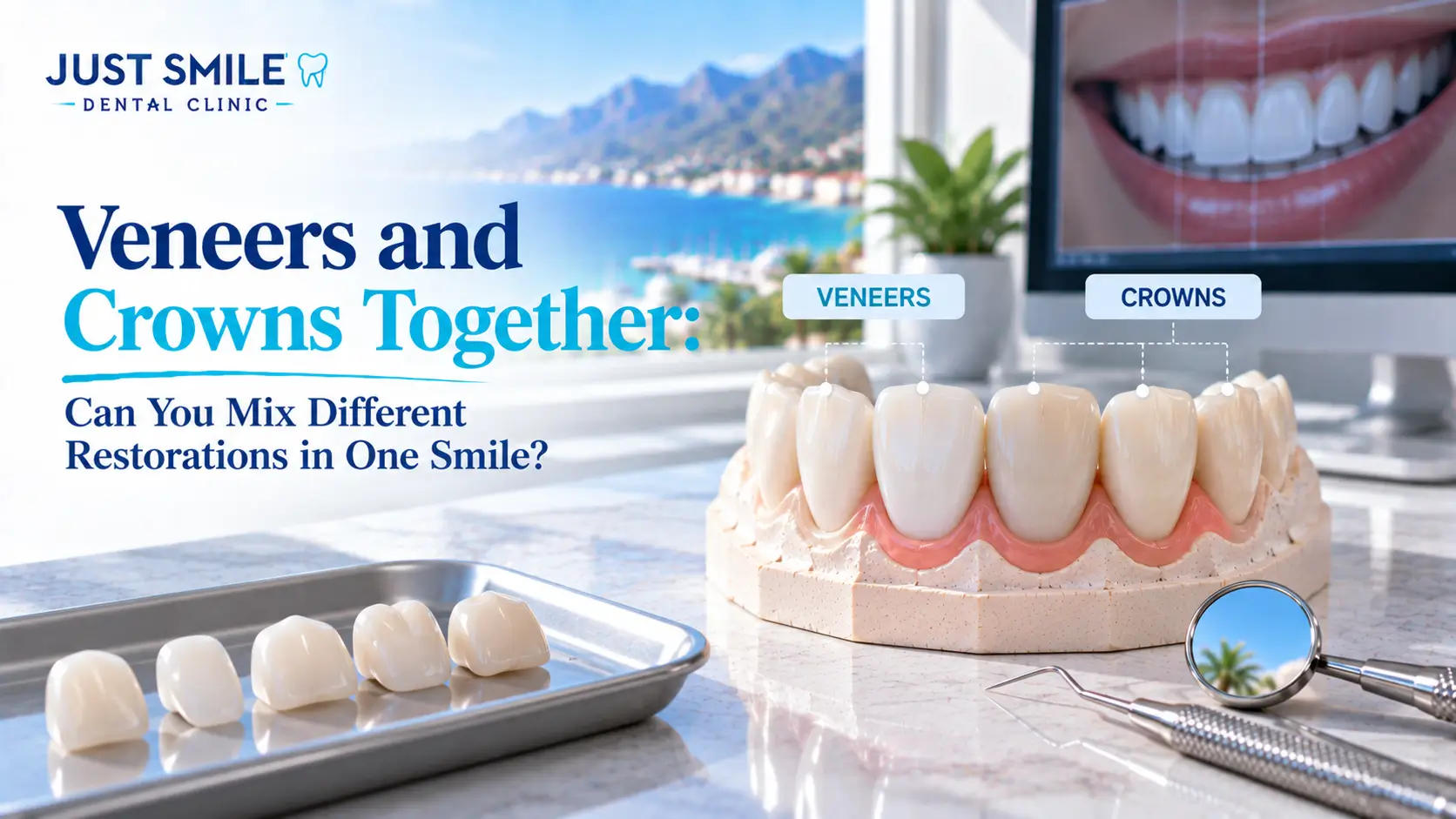
Veneers and Crowns Together: Can You Mix Different Restorations in One Smile?
Quick Answer
Yes, you can have veneers and crowns together in the same smile.
In fact, using different restorations on different teeth can be more appropriate than treating every visible tooth in exactly the same way.
A healthy front tooth that mainly needs a cosmetic change may be suitable for a veneer, while a heavily restored, weakened or structurally damaged tooth beside it may need a crown. Another tooth may not need any restoration at all.
The challenge is making those different treatments look and function like one smile.
At JST Dental, the restoration should follow the condition of each individual tooth rather than forcing every tooth into the same treatment package.
Why Would One Smile Need Both Veneers and Crowns?
Because teeth that sit next to each other can have completely different histories.
Imagine six upper front teeth.
One may be completely healthy but slightly discoloured.
Another may have a large old filling.
A third may have previously undergone root canal treatment.
Another may have a fracture.
And two may already have a shape and colour that fit the planned smile perfectly.
They may all appear in the same photograph.
That does not mean they all need the same restoration.
A cosmetic treatment plan should therefore answer two separate questions:
What should this smile look like?
and
What does each individual tooth actually need?
Only after both questions are answered should the final combination of restorations be decided.
What Is the Main Difference Between a Veneer and a Crown?
A veneer and a crown can both improve the appearance of a tooth, but they cover different amounts of natural tooth structure.
A veneer primarily covers the visible front surface of the tooth.
A crown surrounds much more of the tooth and provides full coverage.
This difference is clinically important.
Veneers are often considered when the main objective involves:
- Tooth colour.
- Shape.
- Minor chips.
- Small spaces.
- Limited cosmetic alignment concerns.
- Changes to tooth proportions.
Crowns may be considered when the tooth also needs greater structural protection because of:
- Extensive previous fillings.
- Major fractures.
- Significant loss of tooth structure.
- Severe wear.
- Certain root-canal-treated teeth.
- Existing crowns that require replacement.
The final decision depends on the actual tooth rather than the appearance alone.
Why Not Put Crowns on Every Tooth So Everything Matches?
Because matching the smile is not the only objective.
Preserving natural tooth structure matters too.
A crown generally requires more extensive tooth preparation than a veneer because the restoration surrounds the tooth.
If a healthy tooth can achieve the required result with a more conservative restoration, preparing it for full coverage simply so every tooth receives the same treatment may remove more natural structure than necessary.
This is one reason the question should not be:
“How many crowns do I need for a smile makeover?”
It should be:
“Which teeth genuinely require crowns?”
Consistency in the final appearance does not require identical treatment underneath.
Why Not Use Veneers on Every Tooth Instead?
The opposite approach can also create problems.
A veneer does not provide the same type of coverage as a crown.
If a tooth is heavily compromised, simply placing a veneer on its front surface may not address the underlying structural problem.
For example, a tooth with a very large existing restoration may have relatively little natural structure remaining.
Another may already have a crown.
Another may require more extensive protection because of a fracture.
In those situations, choosing a veneer simply to keep the treatment plan uniform would put aesthetics ahead of the condition of the tooth.
The restoration type should therefore follow the clinical requirement.
Can a Crown and Veneer Next to Each Other Look the Same?
They can be designed to blend closely, but this requires careful planning.
The dentist and dental technician need to coordinate:
- Shade.
- Brightness.
- Translucency.
- Surface texture.
- Tooth length.
- Width.
- Incisal character.
- Gum relationships.
The difficulty is that a crown and veneer do not have exactly the same structure.
A veneer is relatively thin and may allow more influence from the tooth beneath it.
A crown has different thickness and masking requirements because it surrounds more of the tooth.
The laboratory therefore cannot simply manufacture both restorations using the same shade code and assume they will look identical once placed.
The final visual result matters more than the label written on the laboratory prescription.
The Tooth Underneath Each Restoration Is Different
Suppose a veneer is placed over a naturally light tooth.
Next to it, a crown is being placed over a dark root-canal-treated tooth.
The starting colours are different.
The thicknesses of the restorations are different.
Their masking requirements may also be different.
Yet from the outside, they need to belong to the same smile.
This is where ceramic selection, translucency and laboratory communication become important.
The objective is not necessarily to use exactly the same material configuration for every tooth.
It is to create a visually coherent result despite the different conditions underneath.
Can Some Teeth Stay Completely Natural?
Yes.
This is one of the most important parts of mixed restorative planning.
A smile makeover does not automatically require every visible tooth to receive a restoration.
If a natural tooth:
- Has a favourable shape.
- Is structurally healthy.
- Fits the planned shade.
- Integrates with the overall smile.
there may be no reason to cover it simply because neighbouring teeth are receiving veneers or crowns.
Sometimes whitening can help untreated teeth blend with new restorations.
Sometimes no additional procedure is required.
The treatment plan should be based on what needs changing rather than how many units can be placed.
What If I Already Have One Crown on a Front Tooth?
This is common.
Someone may already have a crown on one central incisor and later decide to improve the appearance of the surrounding teeth.
That does not automatically mean the crowned tooth must be replaced.
The dentist first needs to assess:
- Is the existing crown healthy?
- Does it fit properly?
- Is the shade compatible with the proposed smile?
- Is there decay or another problem underneath?
- Can neighbouring restorations be designed around it?
If the crown is clinically sound and aesthetically compatible, it may remain.
If the new smile design would make the old crown visibly mismatched, replacement may be discussed.
The important point is that replacement should have a reason.
What If I Have Root Canal Treatment on One Front Tooth?
A root-canal-treated tooth requires individual assessment.
Root canal treatment by itself does not tell the entire restorative story.
The dentist also needs to evaluate how much natural structure remains, whether large previous restorations are present and whether the tooth needs additional structural protection.
In some anterior cases, a conservative restoration may still be possible.
In others, a crown may be more appropriate.
That tooth can still form part of a smile in which neighbouring teeth receive veneers.
The treatment does not need to be identical for the final appearance to be harmonious.
Mixing Restorations Can Actually Be More Conservative
At first, a mixed plan can sound more complicated.
For example:
4 veneers + 2 crowns
may sound less straightforward than:
6 crowns
But the mixed plan may preserve significantly more natural tooth structure if four of those teeth do not require full coverage.
Treatment simplicity should not be confused with biological conservatism.
Sometimes the more individualised plan is more complex to design precisely because each tooth has been assessed separately.
That can be a good thing.
Example: Six Front Teeth, Three Different Decisions
Consider a hypothetical patient concerned about the upper six front teeth.
Tooth 1
Healthy, but slightly short.
Possible approach: veneer.
Tooth 2
Healthy, but significantly discoloured.
Possible approach: veneer depending on masking requirements.
Tooth 3
Large old filling and major structural loss.
Possible approach: crown.
Tooth 4
Existing crown with poor margins.
Possible approach: replacement crown.
Tooth 5
Healthy and already attractive.
Possible approach: leave natural.
Tooth 6
Minor shape difference.
Possible approach: bonding or no treatment.
One smile.
Six teeth.
Several different decisions.
That is what personalised restorative planning actually looks like.
How Do Dentists Make Different Restorations Look Like One Smile?
The final smile needs one shared visual language.
That includes coordinated:
Tooth proportions
The restorations should work together in width and length.
Shade
Brightness should be balanced across veneers, crowns and any remaining natural teeth.
Surface character
A crown should not be extremely smooth while the veneer beside it contains obvious texture.
Incisal edges
Front-tooth edge positions should contribute to one consistent smile arc.
Gum relationships
Restorations should emerge naturally from the surrounding soft tissues.
Tooth character
Central incisors, lateral incisors and canines should retain their different visual roles.
The person looking at the final smile should not immediately be able to identify:
“These two are crowns and those four are veneers.”
They should simply see one smile.
Do Crowns and Veneers Age Differently?
Potentially.
Different materials and different underlying teeth can respond differently over time.
Natural teeth can also change colour while ceramic restorations remain relatively stable.
This is another reason long-term planning matters when new restorations will sit beside untreated teeth.
Good oral hygiene, regular dental examinations and management of habits such as grinding remain important regardless of restoration type.
The goal is not only to make the restorations match on placement day.
It is to create a maintainable smile.
What Should Be Decided First: Smile Design or Restoration Type?
Both inform each other.
Starting only with the restoration type can lead to:
“We are doing 20 crowns. Now let us design them.”
Starting only with appearance can create the opposite problem:
“We want this exact smile. Now let us make every tooth fit it.”
A better process moves between the two.
First:
What does the patient want to change?
Then:
What condition is each tooth in?
Then:
Which treatments can achieve the aesthetic objective while respecting the biology and structure of those teeth?
The final smile design and restorative plan develop together.
How JST Plans Veneers and Crowns Together
At JST Dental, both veneers and crowns are available within the same restorative and cosmetic workflow.
The important part is deciding why each tooth receives one rather than the other.
The clinical team can assess:
Does this tooth mainly need an aesthetic surface change?
Does it also need structural reinforcement?
How much healthy enamel remains?
Is there already a crown or large restoration?
Can this tooth remain completely natural?
Can different restorations be made to blend within one smile?
This fits JST’s wider approach of creating a treatment plan around the individual rather than applying one restoration type to every visible tooth.
Questions to Ask About a Mixed Smile Makeover
If your proposed plan includes both veneers and crowns, ask:
- Why does this tooth need a veneer?
- Why does this tooth need a crown?
- Could either tooth be treated more conservatively?
- Which teeth can remain natural?
- How will the different restorations be colour-matched?
- Will existing crowns need replacement?
- How does my bite affect the decision?
- Can I review the proposed overall smile before final placement?
You should understand the reason behind each restoration.
Frequently Asked Questions
Can you have veneers and crowns together?
Yes. Veneers and crowns can be used in the same smile when different teeth have different structural and aesthetic requirements.
Will veneers and crowns look different?
They can be designed to blend closely. Ceramic selection, shade, translucency, texture and the underlying tooth all influence how well different restorations match.
Should all my front teeth be crowns if one needs a crown?
No. One tooth requiring a crown does not automatically mean neighbouring healthy teeth need full coverage.
Can a veneer go next to a zirconia crown?
Yes. The materials and optical properties need to be planned carefully so the restorations integrate visually.
Can natural teeth stay between crowns and veneers?
Yes, where those teeth are healthy and visually compatible with the final plan.
Is mixing veneers and crowns better than using only crowns?
Neither approach is automatically better. The appropriate restoration should be selected according to the condition and requirements of each tooth.
Veneers and Crowns Together Should Look Like One Smile, Not One Treatment Package
Using veneers and crowns together may sound less uniform than using one restoration across every tooth.
Clinically, that can be exactly the point.
Teeth are not uniform.
Some are healthy.
Some have previous dental work.
Some need cosmetic changes.
Some need structural protection.
Some do not need treatment at all.
At JST Dental in Antalya, the aim is therefore not to make every tooth receive the same restoration.
It is to give each tooth the level of treatment it actually needs and then make those different decisions come together as one natural-looking smile.
The restorations can be different.
The result should not feel that way.