

Natural Veneer Shape: Why Your Front Teeth Shouldn’t All Be the Same Length
Quick Answer
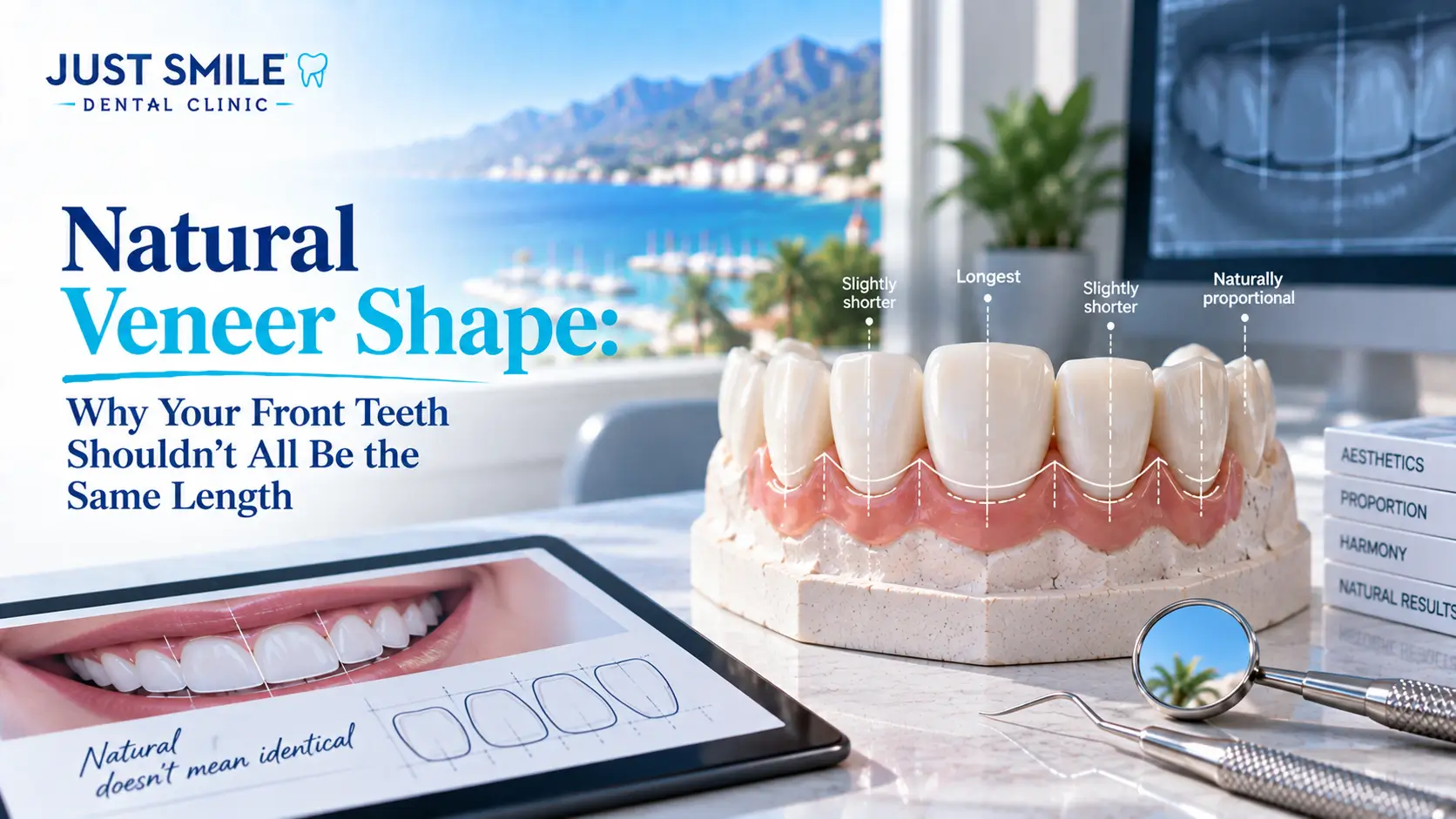
A natural veneer shape should preserve the visual differences between central incisors, lateral incisors and canines rather than making every front tooth identical.
Natural front teeth usually vary in width, length, edge position, corner shape and surface anatomy. These differences create rhythm across the smile.
At JST Dental, the objective is not to reproduce the same perfect tooth six, eight or ten times. Each veneer should contribute to one balanced smile while retaining the character expected from that particular tooth.
Why Identical Veneers Can Look Artificial
Symmetry is important in cosmetic dentistry.
Uniformity is something different.
If every front tooth has:
- The same length.
- The same width.
- The same corners.
- The same edge.
- The same surface.
- The same visual weight.
the result may be extremely neat.
It may also look manufactured.
Natural dentition contains structure and variation.
The central incisors are different from the lateral incisors.
The lateral incisors are different from the canines.
Those differences help us recognise the teeth as a natural group rather than a repeated set of ceramic units.
What Is a Natural Veneer Shape?
There is no single shape called “natural”.
A natural veneer shape is better understood as a shape that makes sense within:
- The person’s existing anatomy.
- Facial proportions.
- Smile width.
- Lip movement.
- Neighbouring teeth.
- Gum contours.
- Bite.
- Desired aesthetic direction.
This means two people can receive very different veneer shapes and both results can look natural.
The objective is not to find the universal perfect tooth.
It is to identify the form that fits the individual smile.
Central Incisors Should Have Visual Importance
The two upper central incisors sit at the centre of the smile.
They usually play the strongest visual role.
Their length, width and position strongly influence how the complete smile is perceived.
If central incisors are made too small, the centre of the smile can lose definition.
If they become too large, they can dominate the face.
Their shape therefore needs balance.
Central incisors commonly appear more rectangular than the lateral incisors, although natural anatomy varies considerably.
The important principle is that they should not simply become one of several identical teeth.
They usually need enough visual presence to establish the centre of the smile.
Lateral Incisors Need Their Own Character
The lateral incisors sit directly beside the central incisors.
They are generally smaller and can create a softer visual transition.
This difference is extremely important in veneer design.
If lateral incisors are made:
- The same length as the central incisors.
- Almost the same width.
- Equally square.
- Equally dominant.
the front four teeth can begin to merge visually into one repetitive group.
A natural-looking design often gives lateral incisors a slightly different role.
That difference may come from:
- Length.
- Width.
- Corner shape.
- Edge position.
- Rotation.
- Surface contour.
The variation does not need to be dramatic.
Small differences can be enough.
Canines Should Not Look Like Incisors
Canines sit at an important transition point.
They connect the front teeth with the posterior part of the dental arch.
Natural canines commonly have a stronger and more distinctive shape than lateral incisors.
If veneer design makes them too square, too flat or too similar to the incisors, the transition toward the side of the smile can disappear.
A wide smile containing eight or ten restorations makes canine design particularly important.
The smile should not suddenly look as if the front-tooth design has simply been copied further backwards.
Why Tooth Length Should Vary
The biting edges of the upper front teeth contribute to the shape of the smile.
Central incisors, lateral incisors and canines do not necessarily end at exactly the same vertical position.
These subtle differences help form the smile arc.
If every veneer is designed to the same length, the upper edge pattern can become flat.
This does not mean every natural smile requires a dramatic curve.
It means the edge positions should be planned together rather than levelled automatically.
The relationship with the lower lip is particularly important.
Natural Does Not Mean Random
Once people hear that perfect symmetry can look artificial, there is a risk of going too far in the opposite direction.
Natural-looking dentistry is not created by deliberately making teeth crooked or mismatched.
The differences need to be controlled.
Think of it as structured variation.
The central incisors can remain balanced with each other while the lateral incisors have a slightly different length.
The canines can have stronger character without becoming distracting.
Small asymmetries can remain where they help the smile feel individual.
The aim is harmony, not disorder.
Why Width-to-Length Ratio Matters
A tooth’s shape is strongly influenced by the relationship between its width and length.
Consider two veneers of equal length.
If one is wider, it may look:
- Squarer.
- Shorter.
- Heavier.
If the other is narrower, it may appear:
- Longer.
- More delicate.
- More vertical.
Dentists can use proportional guidelines when assessing these relationships.
But there is no single mathematical formula that defines a natural smile for everyone.
Facial dimensions, existing anatomy and personal preferences all change what looks appropriate.
Proportions should guide the design.
They should not replace judgement.
What Are Line Angles and Why Do They Matter?
The apparent shape of a veneer is not determined only by its outer border.
The front surface contains visual transitions called line angles.
These influence how light defines the visible face of the tooth.
Changing them can make a veneer appear:
- Wider.
- Narrower.
- Squarer.
- More rounded.
This creates an important design opportunity.
Sometimes the physical width of a veneer does not need to change significantly.
Adjusting how the visible surface is shaped can alter the way the tooth is perceived.
Natural veneer shape is therefore partly about optical design.
Corners Change the Personality of a Tooth
Look closely at front teeth and you will notice that the corners are not all identical.
Some are sharper.
Some are softer and more rounded.
The relationship between these corners helps distinguish different teeth.
If every veneer has identical rounded corners, the smile may begin to look repetitive.
If every tooth is aggressively square, the result can feel equally standardised.
Corner design should follow the intended anatomy and complete facial appearance rather than a preset “veneer style”.
Surface Texture Is Part of Shape
Shape is not only the outline.
Natural enamel contains subtle surface anatomy that affects how light moves across the tooth.
A completely flat, highly polished veneer can appear visually different from a neighbouring tooth even if their outer dimensions are similar.
Subtle texture can influence:
- Reflections.
- Perceived width.
- Brightness.
- Visual depth.
This is why natural veneer design needs to consider both macro-shape — the overall tooth form — and micro-shape — the smaller surface details.
Should Men and Women Automatically Receive Different Veneer Shapes?
Not according to a rigid formula.
Terms such as “masculine teeth” and “feminine teeth” are sometimes used in cosmetic design, but they can easily become another type of template.
Facial structure and aesthetic preferences vary greatly between individuals.
A square tooth is not automatically right for every man.
A rounded tooth is not automatically right for every woman.
A more useful approach is to look directly at the person’s:
- Face.
- Existing teeth.
- Lips.
- Age-related characteristics.
- Smile movement.
- Personal preference.
The design should respond to the individual rather than a label.
Age Can Influence the Desired Tooth Character
Natural teeth change over time.
Edges can wear.
Surface texture may become less pronounced.
Small changes in shape and translucency can develop.
This does not mean veneer design should artificially make someone look older or younger.
It means a highly youthful tooth form with pronounced length and character may feel different on one face compared with another.
The final design should make sense as part of the complete facial appearance.
Why Face Shape Alone Should Not Decide Veneer Shape
Another common shortcut is matching one tooth shape directly to one facial category.
For example:
round face = square teeth
or
square face = rounded teeth.
Real facial and dental aesthetics are more complex than this.
Face shape can be considered, but it is only one factor among many.
Lip movement, tooth display, smile width and existing dental anatomy may be more important in a particular case.
Natural veneer shape is therefore created from multiple relationships rather than one matching rule.
How Smile Arc Connects to Veneer Shape
The smile arc connects individual tooth shape with the overall smile.
If central incisors, lateral incisors and canines are given different edge positions, they create a curve across the upper teeth.
That curve should be considered in relation to the lower lip.
This is one reason a natural veneer shape cannot be designed one tooth at a time.
Changing the length of one tooth alters its relationship with the teeth beside it.
Changing several lengths can alter the entire smile arc.
The complete composition matters.
Why Temporary Shapes Are Useful
Digital design provides a useful preview.
Temporary forms can add another level of evaluation because the proposed shapes can be seen inside the mouth.
This can help assess whether:
- The central incisors dominate too much.
- The lateral incisors are too long.
- Canines look too similar to the front incisors.
- The smile arc feels too flat.
- The shapes suit the lips.
- Speech feels natural.
- Tooth length works with the bite.
This is far more informative than deciding whether one isolated veneer looks attractive on a screen.
How JST Plans Natural Veneer Shape
At JST Dental, the objective is to avoid starting from the assumption that everyone needs the same set of teeth.
The team can instead evaluate:
Which teeth naturally dominate the smile?
How wide should the central incisors appear?
How much difference should exist between central and lateral incisors?
Where should the incisal edges sit?
How should the canines transition toward the side of the smile?
Does the smile arc work with the lips?
Are small natural asymmetries worth preserving?
Does the design look appropriate while speaking as well as smiling?
The finished veneers should work together.
But working together does not require looking identical.
Frequently Asked Questions
What is a natural veneer shape?
A natural veneer shape is one that fits the person’s facial proportions, lips, neighbouring teeth and smile while preserving appropriate differences between different tooth types.
Should all veneers be the same length?
Not automatically. Central incisors, lateral incisors and canines can have different edge positions, and these variations contribute to the overall smile arc.
Why do identical veneers look fake?
Natural teeth contain variations in size, anatomy, corners, texture and edge position. Removing all of those differences can make a smile look overly uniform.
Are square or rounded veneers more natural?
Neither is universally more natural. The appropriate shape depends on the complete smile, facial features and the aesthetic direction being planned.
Can veneer shape be changed before final bonding?
The planned shape should be evaluated before final bonding. Digital planning and temporary forms can help identify proportion or shape concerns earlier in the process.
Natural Veneer Shape Is About Harmony, Not Repetition
A natural veneer shape is not created by finding one attractive tooth and repeating it across the smile.
Central incisors need their own visual role.
Lateral incisors need theirs.
Canines need to create a natural transition toward the side.
Their lengths do not always need to match.
Their corners do not need to be identical.
Their surface details do not need to repeat perfectly.
At JST Dental in Antalya, those controlled differences are part of designing a smile that feels individual rather than manufactured.
Because a natural smile does not look like ten versions of the same tooth.
It looks like ten teeth that belong together.