


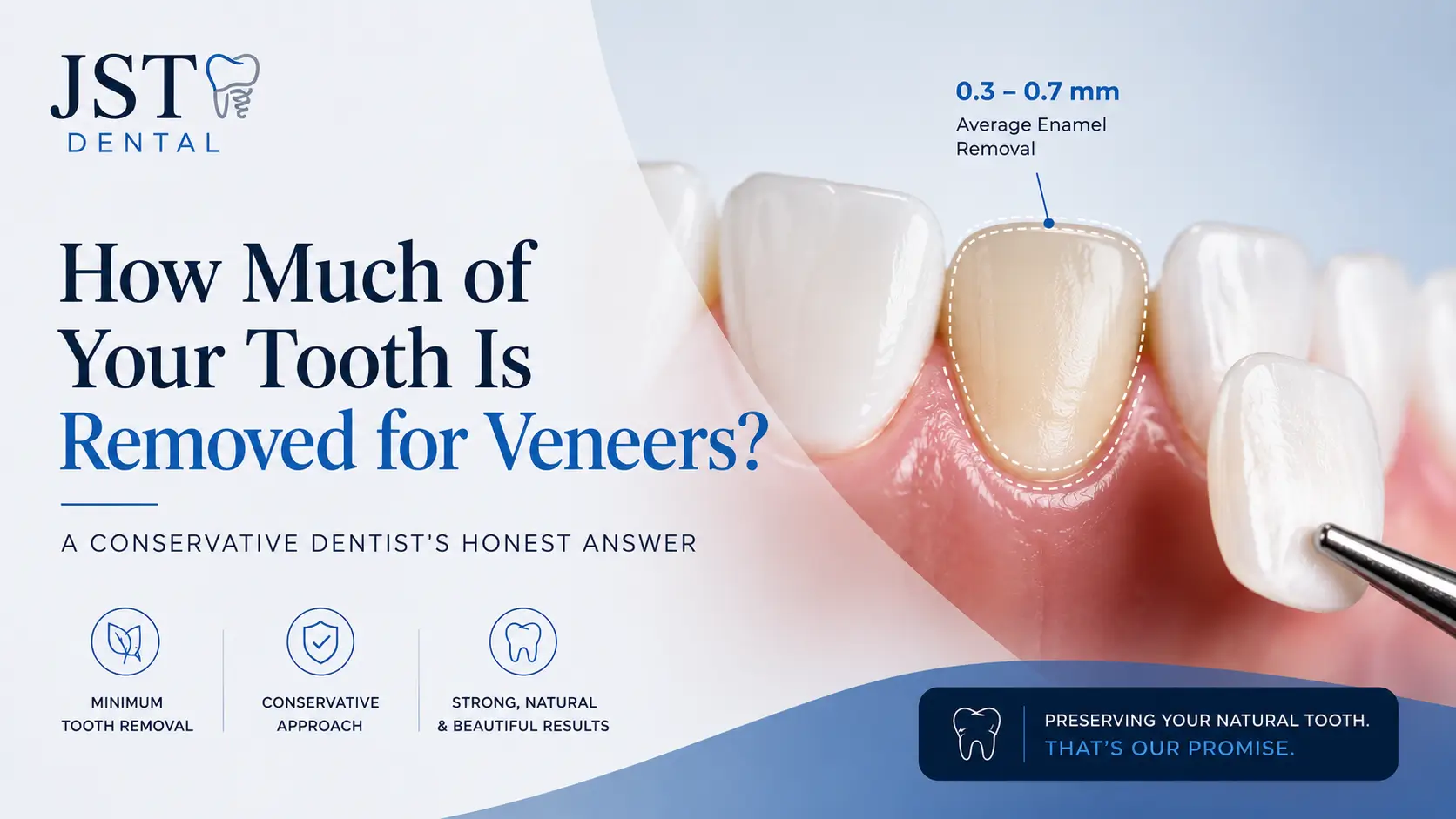
How Much of Your Tooth Is Removed for Veneers? A Conservative Dentist’s Honest Answer
QUICK ANSWER
Veneers usually require only a thin layer of enamel to be removed from the front surface of the tooth, making them a minimally invasive treatment. Crowns are completely different, as they require the tooth to be reduced on all sides.
The best way to protect your teeth is to choose the treatment that is truly right for your case. In some situations, veneers are the healthiest option, while in others, crowns provide the best long-term result. It’s also important to know that some clinics market crowns as veneers and veneers as crowns. Always make sure you understand exactly what treatment you’re receiving and why it’s being recommended.
KEY TAKEAWAYS
• Traditional veneers remove a thin layer of enamel (often around 0.5 mm) from the front.
• No-prep and minimal-prep veneers remove little or no tooth.
• Crowns remove far more — entire tooth.
•If you’re considering veneers, one question matters more than almost any other: how much of your natural tooth has to be removed? It is the single biggest factor in whether your smile stays healthy for decades — and it is exactly where the well-known “Turkey teeth” problems usually begin. The honest answer is that a properly placed veneer removes very little tooth, while a crown removes a great deal more. Knowing the difference is what protects you.
How much tooth is removed for veneers?
For traditional porcelain veneers, only a thin layer of enamel is removed — usually around 0.3 to 0.7 mm from the front of the tooth — while minimal-prep and no-prep veneers remove even less.
The exact amount depends on the type of veneer and the condition and position of your teeth. The aim of a careful dentist is always to remove the minimum needed for the veneer to fit flush and look natural — never more.
Minimal-prep veneers
Even less enamel is touched — often only light contouring. These suit many cases but not all, depending on how your teeth are positioned and how they bite together.
Do veneers ruin or damage your teeth?
No. Properly placed veneers require only a small amount of enamel reduction and do not ruin your teeth. It’s true that enamel doesn’t grow back, so veneers are a long-term commitment and should be chosen carefully. However, conservative veneers are a routine, well-established treatment with excellent long-term results.
The key is choosing the right treatment for the right patient. In some cases, veneers are the most conservative option, while in others, crowns may provide better protection, function, and longevity. Problems usually come from incorrect treatment planning or excessive tooth preparation—not from veneers or crowns themselves when they are done properly.
Veneers vs crowns: how much tooth does each remove?
A veneer mainly covers the front surface and removes a thin layer of enamel; a crown caps the whole tooth and removes substantially more from every side.
- Veneer — covers mainly the front surface; removes roughly 0.3–0.7 mm of enamel; conserves most of the tooth.
- Crown — caps the entire tooth; removes much more structure on all sides; sometimes leaves only a smaller core.
- Why it matters — veneers and crowns serve different purposes. The best choice depends on your tooth structure, functional needs, and long-term treatment goals.
We compare all three options — veneers, crowns and composite bonding — in our guide to the least invasive cosmetic dentistry choices.
Why are healthy teeth sometimes over-prepared?
Because veneers require careful planning, precise preparation, and advanced cosmetic skills. Not every dentist offers them routinely, so crowns may sometimes be recommended instead.
The issue isn’t veneers versus crowns—both are excellent treatments when used correctly. The key is making sure the treatment is chosen for your teeth, not simply because it’s the easier option.
Are veneers reversible?
No-prep veneers are largely reversible, but traditional prep veneers are not fully reversible, because the small amount of enamel removed doesn’t grow back.
That’s exactly why the amount of tooth removed matters so much, and why a careful clinic recommends the least invasive option that will achieve your goal rather than defaulting to more aggressive preparation.
How do you keep tooth removal to a minimum?
Choose a conservative, assessment-led clinic that uses digital planning, considers bonding or minimal-prep options where suitable, and only removes what is genuinely necessary.
- Ask for digital smile design or a mock-up before any tooth is touched.
- Consider composite bonding, which usually removes little or no tooth, where it’s appropriate.
- Request minimal-prep or no-prep veneers if your case allows.
- Insist on a written plan stating the preparation for each individual tooth.
- Choose a clinic willing to tell you that you need less than you thought.
How we approach veneers conservatively at Just Smile
At Just Smile Dental Clinic in Antalya, Turkey, our approach is simple: we recommend the treatment that is most suitable for you.
That’s why every case is carefully reviewed during your online consultation under the supervision of our Head Dentist, Dr. Niyazi Ediboğlu. Your teeth, bite, expectations, and overall oral health are assessed before a treatment recommendation is made, and all available options are explained in detail so you can make an informed decision.
Frequently asked questions about veneer tooth removal
How much enamel is removed for veneers?
For traditional veneers, typically around 0.3–0.7 mm from the front of the tooth; minimal-prep and no-prep options remove less or none.
Do veneers hurt the tooth underneath?
No. Veneers require only minimal preparation and are designed to preserve most of your natural tooth. Once bonded, they become a strong protective layer over the front surface of the tooth.
Are no-prep veneers as good as traditional ones?
They can be excellent in the right cases, and they’re the most conservative option — but they don’t suit every situation, which an in-person assessment confirms.
Will my veneers need replacing?
Veneers can last 15–20 years with good oral hygiene and proper care, although their longevity also depends on the quality of the material used.
Is it better to get veneers or composite bonding?
Composite bonding usually requires little to no tooth preparation. However, because it is made from filling material, it is not considered a lifetime treatment and may require maintenance over time.
The best option depends on your goals—both bonding and veneers have their place when used for the right case.
Want to know exactly what would be removed — before you commit?
Send a few photos for a free online consultation and we’ll give you an honest, written plan stating the approach for each tooth. No obligation.