

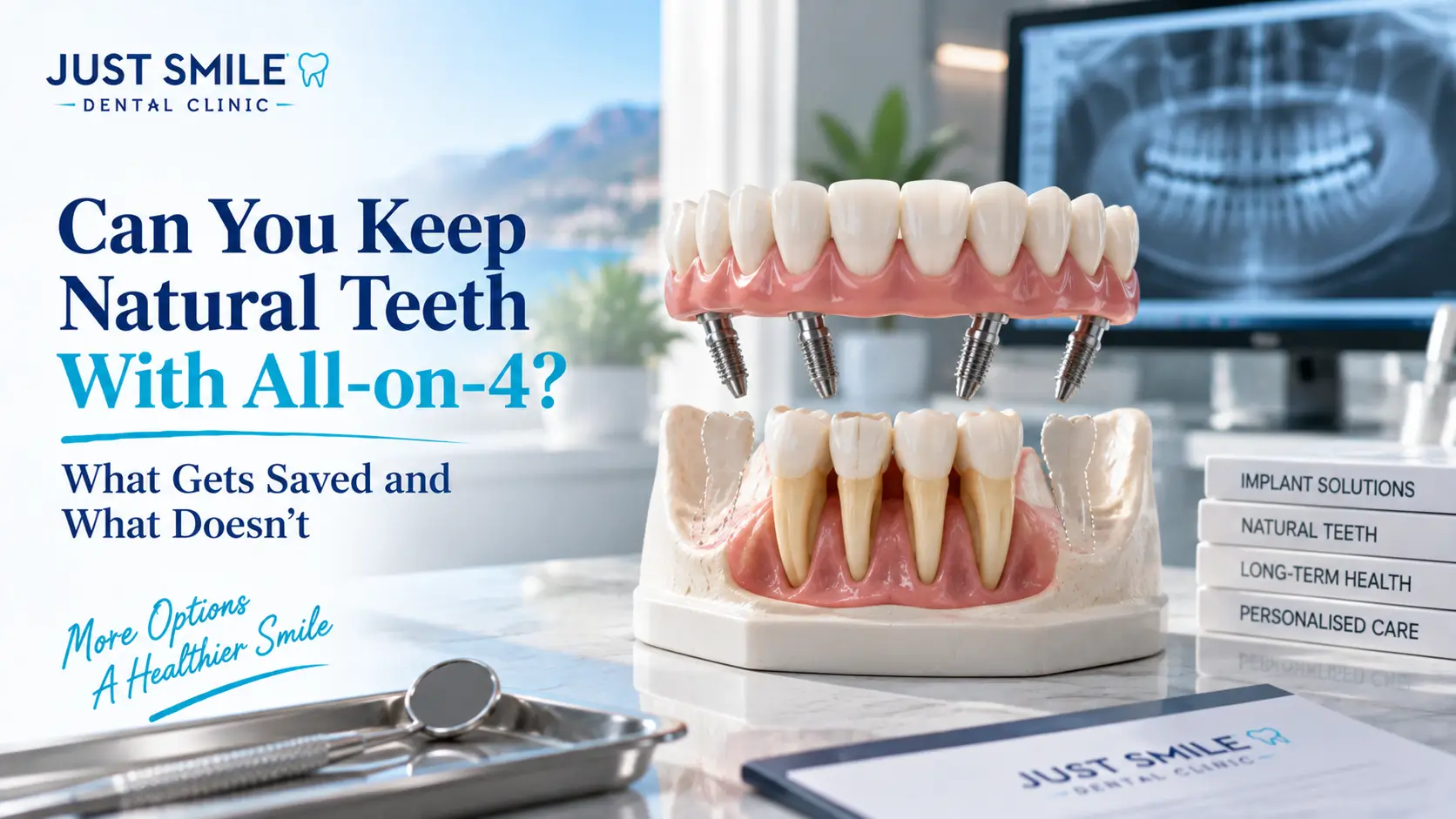
Can You Keep Natural Teeth With All-on-4? What Gets Saved and What Doesn’t
Quick Answer
If you are wondering “can you keep natural teeth with All-on-4?”, the answer depends on where those teeth are and whether All-on-4 is actually the right plan for that arch.
All-on-4 is a complete-arch implant restoration designed to replace an entire row of missing or terminal teeth using four implants supporting one fixed bridge. If strong, maintainable natural teeth remain in the same arch, their value should be assessed before deciding to replace the entire arch.
Healthy teeth in the opposite jaw do not automatically need to be removed.
The important question is therefore not simply whether natural teeth can physically remain, but whether a full-arch replacement is justified in the first place.
All-on-4 Is Not Four Individual Replacement Teeth
Understanding the design makes the answer much clearer.
Four implants are strategically positioned in the jaw to support a single fixed full-arch restoration.
Those implants are not normally placed one-for-one in the positions of four missing teeth.
Instead, the four implants work together as the foundation for a bridge replacing the complete dental arch.
JST Dental currently describes its All-on-4 treatment in exactly this way: four implants per jaw support a fixed full-arch restoration, with two posterior implants commonly angled to make efficient use of the available bone.
That means All-on-4 is fundamentally different from replacing one or two isolated missing teeth with individual implants.
What Happens If You Still Have Some Natural Teeth?
This is where proper diagnosis becomes critical.
Many people considering All-on-4 are not completely toothless.
They may have:
- Several missing teeth.
- Old crowns or bridges.
- Mobile teeth.
- Teeth affected by advanced gum disease.
- Heavily restored teeth.
- A few relatively healthy natural teeth.
The fact that some teeth remain does not automatically mean those teeth should be extracted.
Each tooth needs a prognosis.
The clinical team must decide whether the remaining dentition is:
maintainable,
questionable, or
terminal.
Full-arch implant rehabilitation is generally intended for people who have lost most or all teeth or whose remaining dentition has a sufficiently poor prognosis to justify complete replacement. The American College of Prosthodontists describes full-arch fixed implant restoration as an accepted option for replacing terminal dentition.
Can Healthy Teeth Stay Inside the Same All-on-4 Arch?
This needs an important distinction.
A standard All-on-4 bridge is designed as a complete-arch prosthesis.
If strong, strategically useful natural teeth are to remain in that same jaw, the treatment may no longer be a conventional full-arch All-on-4 plan.
Instead, the dentist may need to ask whether a different, segmented restorative strategy makes more sense.
For example, depending on the individual case, the discussion could involve:
- Keeping maintainable natural teeth.
- Replacing only missing or hopeless teeth.
- Individual implants.
- Smaller implant-supported bridges.
- Restoring existing natural teeth.
- Combining different restorative approaches.
These are not automatically better alternatives.
The point is that valuable natural teeth can change the entire treatment design.
The treatment should not be forced into an All-on-4 template simply because four implants could technically be placed.
Can You Keep Natural Teeth in the Opposite Jaw?
Yes.
Having All-on-4 in one jaw does not mean the natural teeth in the opposite jaw automatically need to be replaced.
For example, someone might have:
Upper jaw: terminal teeth requiring complete rehabilitation.
Lower jaw: healthy or maintainable natural teeth.
A full-arch implant restoration might therefore be considered only for the upper jaw.
The lower natural teeth would then become an important part of planning because the new implant bridge must function against them.
Their position, bite, wear pattern and strength can influence:
- Tooth shape.
- Prosthetic material.
- Occlusion.
- Implant loading.
- Final tooth position.
JST’s full-mouth implant workflow includes evaluation of both bone structure and bite alignment before implant placement for this reason.
When Might Remaining Teeth Need to Be Extracted?
Some remaining teeth genuinely have a poor long-term prognosis.
Examples may include:
- Advanced periodontal bone loss.
- Severe mobility.
- Non-restorable decay.
- Vertical root fractures.
- Repeated endodontic or restorative failure.
- Extensive structural destruction.
- Unfavourable position within the planned full-arch restoration.
- Multiple teeth forming part of an overall terminal dentition.
In those situations, retaining isolated teeth may provide little long-term benefit and can sometimes complicate the prosthetic design.
The American College of Prosthodontists acknowledges that even asymptomatic teeth may occasionally need extraction to facilitate comprehensive prosthodontic rehabilitation.
However, the same guidance stresses the need for risk assessment, discussion of alternatives and avoidance of injudicious extraction of healthy natural teeth.
That balance is the important part.
When Might a Natural Tooth Be Worth Keeping?
A natural tooth becomes more valuable to the treatment plan when it has:
- Good periodontal support.
- Low disease risk.
- A favourable root structure.
- A predictable restorative prognosis.
- A position that can be maintained functionally.
- Reasonable long-term maintenance requirements.
The American College of Prosthodontists specifically notes that retention may be preferable when natural teeth have a low disease risk, favourable roots, long-term maintainability or strategic value within the wider prosthodontic plan.
So the question should not simply be:
“Is this tooth present?”
It should be:
“What is the realistic long-term prognosis of this tooth?”
Why Would Anyone Remove Healthy-Looking Teeth for a Full-Arch Restoration?
Occasionally, a tooth that looks acceptable in isolation can still create problems within a comprehensive rehabilitation.
Examples include teeth that are severely tilted, over-erupted or positioned in a way that prevents a functional prosthetic design.
But this is very different from removing a healthy tooth merely to make treatment simpler.
Professional prosthodontic guidance states that extractions performed to facilitate a larger prosthetic plan require clear discussion of the advantages, disadvantages, alternatives, long-term maintenance and replacement strategy before treatment begins.
That explanation should happen before the tooth is removed.
Why “Full Mouth Implants” Does Not Always Mean Every Tooth Must Go
The terminology can create confusion.
People sometimes contact clinics saying:
“I need full mouth implants.”
But that is a requested procedure, not yet a diagnosis.
After examination, the situation might instead be:
- One terminal arch and one maintainable arch.
- Several hopeless posterior teeth but healthy anterior teeth.
- Extensive old restorations with a mixture of good and poor prognoses.
- Treatable gum disease.
- Individual teeth that could remain useful for years.
JST’s full-mouth dental implant service is intended for people who have lost most or all teeth or whose teeth are severely damaged, rather than being positioned as the automatic solution whenever several dental problems exist.
That difference matters.
Could Keeping One Tooth Change the Whole Treatment Plan?
Potentially, yes.
Imagine an arch where almost every tooth has a hopeless prognosis except two.
There are two very different possibilities:
Scenario A: Those two teeth also have limited long-term value, and retaining them would compromise the overall rehabilitation.
Scenario B: They are strong, strategically positioned and predictably maintainable.
Those situations should not automatically receive identical treatment.
Keeping strategically valuable teeth may lead to a different restorative design.
Conversely, retaining isolated poor-prognosis teeth simply because they are technically still present can create repeated problems later.
Clinical judgement means recognising both possibilities.
Why a Tooth-by-Tooth Prognosis Matters Before All-on-4
Before committing to full-arch implant treatment, it helps to classify every remaining tooth.
| Question | Why it matters |
| Is the tooth periodontally stable? | Determines the quality of its supporting tissues |
| Is it structurally restorable? | Shows whether a predictable restoration is possible |
| Is there active infection? | May require endodontic or extraction decisions |
| Has previous treatment repeatedly failed? | Influences long-term prognosis |
| Is the tooth strategically useful? | May change the restorative design |
| Can it be cleaned and maintained? | Long-term survival depends on maintenance |
| Would retaining it compromise the full-arch result? | Preservation should not create a poor overall outcome |
| Would extracting it sacrifice a good tooth unnecessarily? | Full-arch convenience alone is not enough |
This is why a panoramic X-ray alone is not always sufficient.
Clinical examination and, where indicated, 3D imaging help assess the bone, roots, pathology and implant sites together.
How JST Dental Approaches Remaining Teeth Before All-on-4
At JST Dental, current All-on-4 planning begins with clinical evaluation and 3D imaging before implant positions and the prosthetic design are determined. The clinic then plans either All-on-4, All-on-6 or another implant approach according to anatomy and individual requirements.
For someone who still has natural teeth, an appropriate assessment should therefore ask:
Which teeth are hopeless?
Which teeth are questionable?
Which teeth have a good prognosis?
Would keeping the good teeth improve or compromise the final plan?
Does this person genuinely need a complete-arch solution?
This approach is consistent with JST’s wider philosophy of personalised planning — care that fits the individual rather than a template.
All-on-4 Should Not Become a Reason to Extract Teeth
All-on-4 can be an excellent option for the right person.
For someone struggling with extensive tooth loss, failing dentition or unstable removable dentures, a fixed full-arch restoration can significantly change function and quality of life.
But the existence of an effective implant solution should not reverse the clinical logic.
The sequence should remain:
Assess the natural teeth → identify which teeth genuinely cannot be maintained → define the restorative objective → determine whether All-on-4 is appropriate.
Not:
Choose All-on-4 → remove whatever teeth happen to remain.
The distinction is particularly relevant because professional prosthodontic education continues to warn against treating All-on-4 as a universal answer for every compromised dentition.
What Should You Ask Before Agreeing to Extract Your Remaining Teeth?
If extractions are proposed before All-on-4, ask the dentist:
- Which teeth definitely cannot be saved?
- What is wrong with each one?
- Are any of the teeth still predictably maintainable?
- What would happen if those teeth were kept?
- Would keeping them require a completely different treatment design?
- Why is full-arch replacement preferable in my case?
- What imaging supports the decision?
- What are the long-term maintenance requirements of the implant bridge?
A good treatment plan should be able to answer these questions clearly.
Frequently Asked Questions
Can you keep natural teeth with All-on-4?
Natural teeth elsewhere in the mouth can remain if they are healthy and maintainable. However, conventional All-on-4 replaces a complete dental arch, so valuable teeth remaining within that same arch may change whether All-on-4 is the appropriate treatment at all.
Do all remaining teeth need to be extracted before All-on-4?
Not simply because they are present. Each tooth should first be assessed for its individual prognosis and its role in the overall restorative plan.
Can I have All-on-4 on top and keep my bottom teeth?
Yes, this can be possible when the upper arch needs complete rehabilitation while the lower natural teeth remain maintainable. The bite between the implant restoration and natural teeth must be carefully planned.
What happens if I only have a few good teeth left?
Those teeth should still be assessed individually. In some cases they may be worth preserving; in others, their position or long-term prognosis may make complete-arch rehabilitation more predictable.
Should I get a second opinion before having all my teeth removed?
A second opinion can be useful when apparently healthy or treatable teeth are included in an extensive extraction plan. Extraction is irreversible, so understanding the prognosis of each remaining tooth before treatment is important.
Can You Keep Natural Teeth With All-on-4? The Better Question Comes First
Before deciding which teeth can remain around an All-on-4 plan, there is a more important question:
Do you genuinely need All-on-4 for this arch?
For someone with terminal dentition, a full-arch implant restoration may be a very appropriate solution.
For someone with several strong, maintainable natural teeth, a different restorative design may deserve consideration.
At JST Dental in Antalya, the number of implants should therefore come after the diagnosis — not before it.
Because when natural teeth still have genuine long-term value, they should be part of the treatment-planning conversation before they become part of an extraction list.