

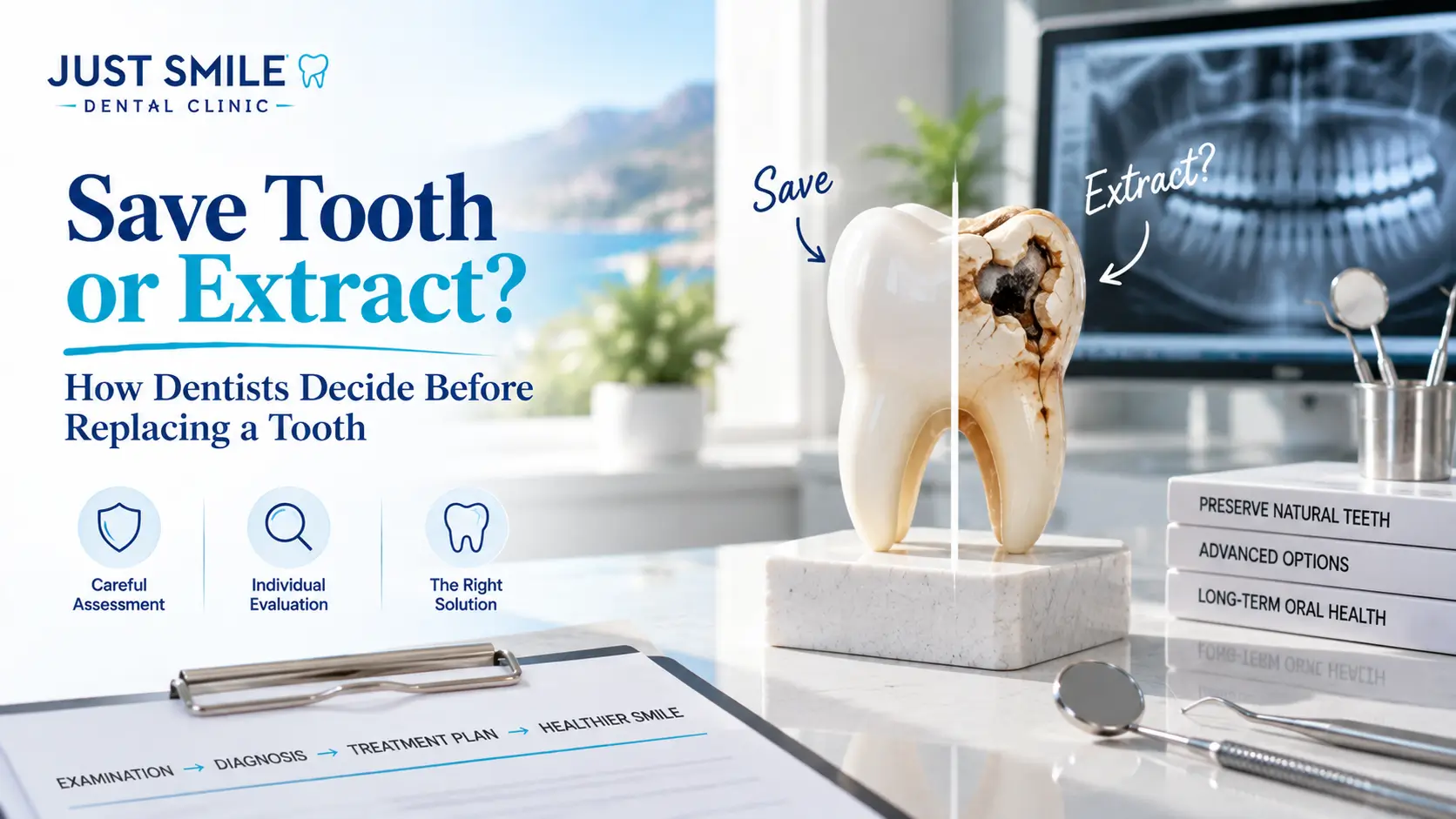
Save Tooth or Extract? How Dentists Decide Before Replacing a Tooth
Quick Answer
When deciding whether to save tooth or extract it, the key question is not simply whether an implant could replace the tooth. Dentists need to assess whether the natural tooth has a predictable future.
The amount of healthy tooth remaining, root condition, cracks, infection, gum and bone support, previous dental work and long-term maintainability all matter. A treatable natural tooth should not automatically be removed simply because implant replacement is possible.
At JST Dental, extraction should be the result of a diagnosis — not the starting point of an implant plan.
Saving a Tooth and Replacing a Tooth Are Two Different Decisions
Dental implants have transformed the way missing teeth can be replaced.
But an implant is designed to replace a tooth that is missing or no longer reasonably maintainable. It does not automatically make a treatable natural tooth obsolete.
This distinction is important.
A systematic review comparing endodontically treated natural teeth with implant-supported replacements found both approaches to be viable and predictable. The available evidence did not support routinely extracting restorable teeth simply in favour of implants.
The American Association of Endodontists similarly states that decisions between retaining a natural tooth and implant replacement should consider factors such as restorability, periodontal status, supporting bone, tooth position and general health.
So before asking:
“Which implant should replace this tooth?”
there is another question to answer first:
“Does this tooth actually need to be removed?”
What Makes a Natural Tooth Worth Saving?
A tooth does not have to be perfect to be maintainable.
Teeth with previous fillings, root canal treatment or periodontal history can sometimes continue functioning for many years when the underlying problem can be treated and the tooth can be restored predictably.
A dentist therefore looks at the entire prognosis.
| What is assessed? | Why it matters |
| Remaining tooth structure | Determines whether the tooth can be restored predictably |
| Root condition | Root fractures or severe structural damage can significantly affect prognosis |
| Infection | Some infections can be treated endodontically rather than requiring extraction |
| Bone support | Severe periodontal bone loss may reduce long-term stability |
| Tooth mobility | May indicate advanced periodontal or structural problems |
| Existing restorations | Multiple previous failures can change the prognosis |
| Crack location | Some cracks are manageable while others make the tooth non-restorable |
| Bite forces | Heavy loading can affect a weakened tooth |
| Ability to maintain the tooth | Long-term cleaning and professional maintenance matter |
The decision is therefore rarely based on one finding alone.
When Can Root Canal Treatment Help Save a Tooth?
One common reason people believe a tooth needs to be extracted is infection inside the tooth.
But infection of the dental pulp does not automatically make extraction necessary.
Root canal treatment is designed to remove infected or damaged pulp tissue, clean and seal the internal space and allow the natural tooth to remain in function.
Afterwards, the tooth may require a filling or another restoration depending on how much structure remains.
Endodontic organisations specifically recommend considering tooth-preserving treatment before extraction when a tooth is restorable.
However, root canal treatment cannot solve every problem.
If the root itself is vertically fractured, the remaining tooth cannot be predictably restored or periodontal support is extremely poor, extraction may still become the more appropriate decision.
When Might Extraction Be the Better Option?
There are situations where attempting to preserve a tooth may only delay an inevitable failure.
Examples can include:
- A non-restorable fracture extending through the root.
- Extensive decay leaving insufficient healthy structure for a reliable restoration.
- Severe periodontal bone loss with a very poor prognosis.
- Repeated failure where predictable retreatment is no longer possible.
- Structural damage extending too far beneath the gum or bone.
- A tooth whose position or prognosis creates major problems within a larger restorative plan.
These situations should be assessed individually.
The objective is not “save every tooth at any cost.”
It is to distinguish between a tooth that is compromised but treatable and one that has reached the point where replacement offers the more predictable route.
What About a Cracked Tooth?
A cracked tooth is a good example of why diagnosis matters.
Not every crack means the tooth must be extracted.
Cracks differ in depth, direction and location. Some involve only part of the crown and may be managed restoratively. Others extend vertically through the root and significantly worsen the prognosis.
The American Association of Endodontists has specifically warned against assuming that all cracked teeth are automatically hopeless, emphasising that some teeth previously considered unsalvageable may still be treatable.
The dentist therefore needs to identify what type of crack is present before discussing replacement.
Is an Implant Better Than a Natural Tooth?
It is more useful to think of implants as an excellent replacement for teeth that genuinely need replacing.
They are not biological upgrades for healthy or predictably maintainable natural teeth.
Research comparing long-term natural-tooth and implant survival has found that implant survival does not automatically exceed the survival of compromised teeth that have been appropriately treated and maintained.
Implants also require their own long-term care.
They can experience biological complications around the implant tissues as well as mechanical complications involving screws, prosthetic components or restorations.
So the comparison should not be:
damaged tooth vs perfect implant.
It should be:
realistic prognosis of retaining this tooth vs realistic prognosis, surgery and maintenance involved in replacing it.
A Tooth Can Always Be Extracted Later
This is an important part of treatment planning.
Extraction is irreversible.
Once the natural tooth has been removed, the decision to preserve it no longer exists.
A carefully selected attempt to retain a tooth does not necessarily remove the possibility of implant replacement later if the tooth eventually fails.
This does not mean a dentist should repeatedly perform low-prognosis procedures on a hopeless tooth.
It means that when the prognosis is genuinely reasonable, tooth preservation deserves to be considered before an irreversible extraction.
A systematic review of long-term outcomes highlighted exactly this point: a compromised tooth may sometimes be maintained successfully, while extraction is a definitive decision and implant therapy can itself involve surgical procedures and future complications.
What If One Dentist Says “Save It” and Another Says “Extract It”?
This is one of the situations where a dental second opinion can be particularly useful.
Different dentists may weigh prognosis differently, particularly in borderline cases.
Instead of simply asking which dentist is correct, compare their reasoning:
| Question | Why ask it? |
| What exactly makes the tooth questionable? | Identifies the diagnosis |
| Is the tooth technically restorable? | Separates structural problems from replacement preference |
| What is the expected prognosis if it is retained? | Makes the long-term expectation clearer |
| What treatment would be needed to save it? | Shows the complexity of preservation |
| Why would extraction improve the prognosis? | Forces a clinical justification |
| What happens if we monitor the tooth? | Clarifies urgency |
| What will replace the tooth after extraction? | Extraction should not be considered in isolation |
If the plans remain very different, reviewing the X-rays, scans and clinical findings can help explain why.
Why This Decision Matters Before Full-Mouth Dental Implants
The question becomes even more important when someone is considering extensive implant rehabilitation.
A person may arrive with several missing teeth, several damaged teeth and several natural teeth that still appear reasonably maintainable.
It should not automatically follow that every remaining tooth belongs in the same category.
A full-mouth implant plan may be very appropriate for someone with terminal or severely compromised dentition.
But the decision to move to a full-arch solution should include an assessment of whether strategically important natural teeth still have a good long-term prognosis.
The American College of Prosthodontists notes that retaining natural teeth can be particularly preferable when those teeth have a low disease risk, favourable roots, long-term maintainability or an important role in the wider restorative plan.
How JST Dental Approaches the Save Tooth or Extract Decision
JST Dental offers both restorative dentistry and implant-based rehabilitation.
That is important because the assessment does not need to begin with only one possible outcome.
The clinic’s wider philosophy is “care that fits you, not a template”, with individual treatment plans built around the person’s existing teeth, goals and clinical situation.
For a questionable tooth, the useful questions are:
Can the tooth be restored?
How predictable would that restoration be?
What healthy tooth and bone remain?
What maintenance would preserving it require?
Would retaining it improve or complicate the wider treatment plan?
What would be gained by extraction?
Only after those questions are answered does implant replacement become a meaningful comparison.
Frequently Asked Questions
Is it always better to save a natural tooth?
No. A tooth with a hopeless or very poor prognosis may be better removed and replaced. The goal is to preserve natural teeth when doing so remains clinically predictable, not to retain every tooth regardless of condition.
Should I extract a tooth or have a root canal?
If the tooth is restorable and the main problem involves the pulp or root canal system, root canal treatment may allow it to remain in function. Root fractures, severe structural loss or poor periodontal support can change that decision.
Is a dental implant more reliable than a root canal?
Both can have predictable outcomes in appropriately selected cases. Evidence does not support assuming that implant replacement is automatically superior to retaining and treating a restorable natural tooth.
Can a badly damaged tooth still be saved?
Sometimes. The key issue is not simply how damaged the tooth looks, but how much sound structure remains, whether the root is intact, whether infection can be managed and whether the tooth can be restored predictably.
Should I get a second opinion before extracting a tooth?
It can be particularly useful when the tooth is asymptomatic, when different options have been suggested or when extraction is part of a much larger implant plan. Extraction is irreversible, so understanding the reason for it is important.
Save Tooth or Extract? Start With the Prognosis
The correct answer is not automatically “save it” and it is not automatically “replace it with an implant.”
It is:
What gives this individual tooth the most sensible long-term prognosis?
Sometimes that means root canal treatment, periodontal care or a new restoration.
Sometimes it means extraction followed by implant replacement.
And sometimes the most important part of the decision is recognising that a tooth does not need to be removed simply because another technology exists to replace it.
At JST Dental in Antalya, the aim is to make that distinction before irreversible treatment begins.