

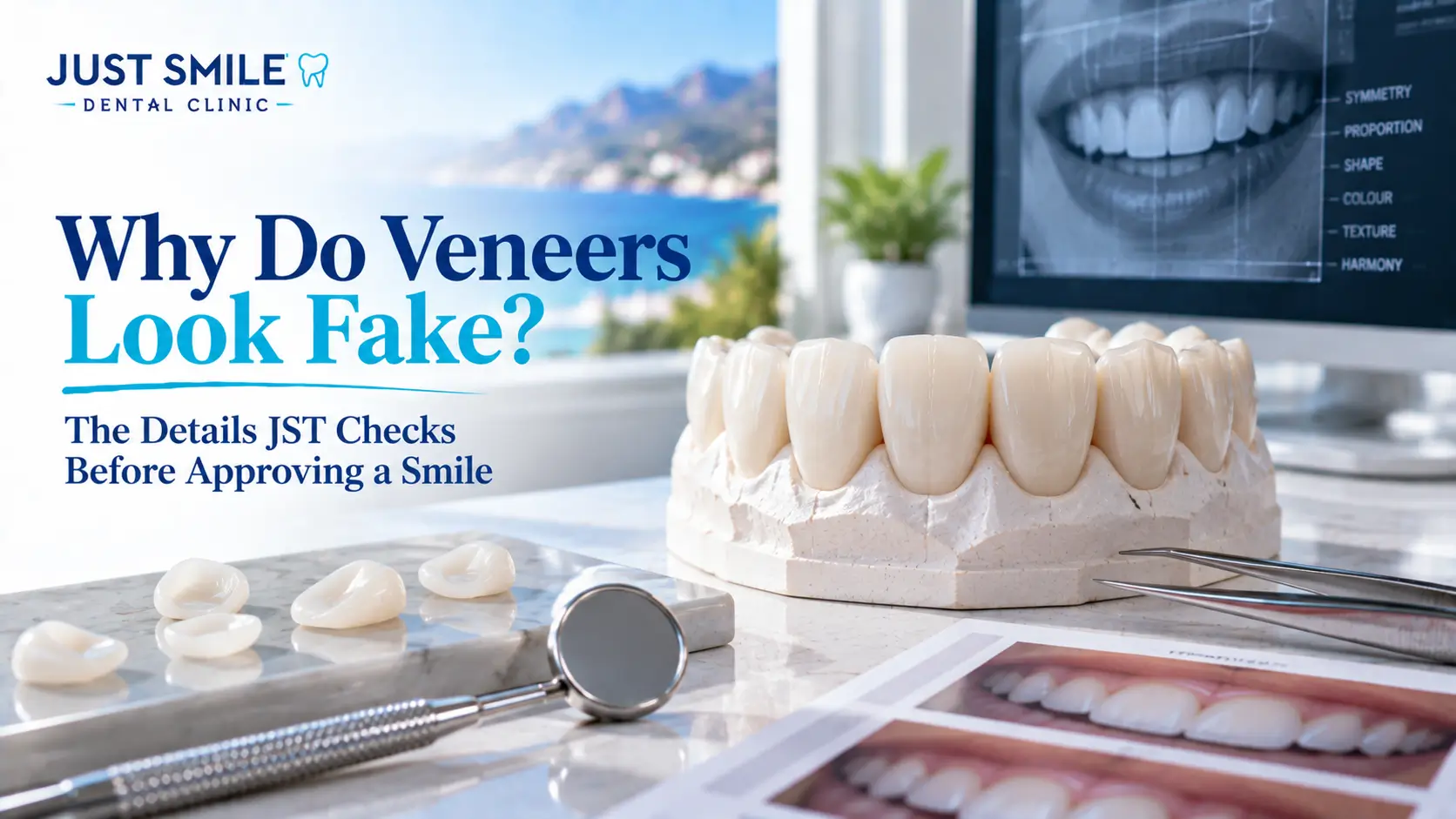
Why Do Veneers Look Fake? The Details JST Checks Before Approving a Smile
Quick Answer
If you are wondering why veneers look fake, the problem is rarely just that they are “too white”.
Veneers can appear artificial when the teeth are too identical, too opaque, too bulky, too smooth or poorly proportioned for the face. The smile line, gum position, tooth length, translucency, surface texture and subtle differences between central incisors, lateral incisors and canines all contribute to whether the final result looks natural.
At Just Smile Dental Clinic in Antalya, Turkey, a natural-looking smile should not look like the same tooth has simply been copied across the arch. Each tooth should be designed to work with the overall smile and facial features.
Fake-Looking Veneers Usually Have More Than One ProbLlem
People often describe artificial veneers with phrases such as:
“They look like blocks.”
“They are all the same.”
“They look too white.”
“They look like plastic.”
Those descriptions are subjective, but they often point toward real design variables.
Natural smile aesthetics depend on the relationship between the teeth, gums, lips and face rather than one characteristic in isolation.
This means veneers can be beautifully made individually and still look unnatural as a complete smile.
The question should therefore not be:
“Does each veneer look perfect?”
It should be:
“Does the whole smile look believable?”
1. Every Tooth Is Exactly the Same Shape
Natural front teeth have different roles and different anatomy.
The central incisors usually dominate the smile.
The lateral incisors are generally smaller and can have softer characteristics.
The canines create an important transition toward the side of the dental arch.
If the same width, length and outline are repeated across every tooth, the result can begin to look manufactured.
Natural-looking design is not about forcing every smile into the same ratio.
It is about creating proportions that work together and fit the individual face.
2. The Veneers Are Too White for the Rest of the Face
White teeth are not automatically fake-looking teeth.
But brightness exists in context.
Skin tone, lip colour, visible lower teeth and even the overall facial appearance can influence how dental brightness is perceived.
An extremely bright shade can therefore look striking on one person and disconnected on another.
The more important question is not:
“What is the whitest shade available?”
It is:
“How bright can this smile become while still looking coherent?”
This is also why shade should be chosen alongside shape, translucency and surface texture rather than as an independent decision.
3. The Veneers Are Too Opaque
Opacity can help mask underlying discolouration.
But excessive opacity can remove visual depth.
Natural teeth contain enamel and dentine with different optical properties.
Light enters, scatters and reflects through these structures rather than simply bouncing off an entirely solid white surface.
When veneers are excessively opaque, the result may appear:
- Flat
- Dense
- Chalky
- Uniform
This is where the common description “they look like plastic teeth” can come from.
Natural appearance requires the correct balance between masking the underlying tooth and allowing the ceramic to retain optical depth.
4. The Teeth Are Too Bulky
A veneer adds material to the visible surface of a tooth.
The final contour therefore needs careful planning.
If the underlying tooth position, preparation and ceramic thickness are not properly coordinated, the restored tooth can become over-contoured.
Visually, this may make the teeth appear:
- Too thick
- Too rounded
- Too prominent
- Too large for the lips
It can also affect how the restoration emerges near the gum line.
This is one reason cosmetic planning cannot be reduced to choosing a shape from a catalogue.
The dentist needs to know where the tooth begins, where the final ceramic surface should end and how much room exists between those two points.
5. Every Tooth Is the Same Length
Natural anterior teeth do not normally create a perfectly flat white line.
The central incisors, lateral incisors and canines usually create different edge positions.
The objective is not to apply one fixed measurement to everyone.
It is to recognise that variation is part of natural dental anatomy.
If every veneer ends at exactly the same height, the smile can lose some of the rhythm seen in natural dentition.
6. There Is No Surface Texture
Perfectly polished ceramic might sound desirable.
But natural enamel is not visually featureless.
It contains subtle texture that changes how light reflects from different areas of the tooth.
If veneers are excessively smooth and reflective, they can appear brighter and more uniform than natural enamel.
This is one reason two veneers with the same nominal shade can look completely different.
The difference may be in how the surface manages light.
7. The Smile Does Not Fit the Lips
Teeth should not be designed independently from the mouth around them.
When a person smiles, the lips create a moving frame.
The amount of tooth displayed, smile width and curvature of the lower lip all influence how the teeth are perceived.
A veneer design that looks attractive on an isolated digital image of teeth may not necessarily look natural when the person speaks or smiles broadly.
The face has to remain part of the design.
8. The Gum Line and Teeth Do Not Work Together
Veneers end near the gums, which means the surrounding gum tissue becomes part of the visible result.
At Just Smile Dental Clinic in Antalya, Turkey, differences in gum height, inflammation or uneven contours can make otherwise attractive veneers feel disconnected from the natural smile. This does not mean every cosmetic case needs gum reshaping. Often, it means the opposite.
The existing gum architecture should first be assessed and respected. Any change should have a clear clinical or aesthetic reason rather than forcing every patient into one symmetrical template.
9. The Canines Have Been Designed Like Central Incisors
One of the easiest ways to create an overly uniform smile is to erase the character of different tooth types.
Central incisors have one visual role.
Lateral incisors have another.
Canines usually provide a stronger transition into the side of the smile.
When all three are given similar width, corner shape and edge character, the smile can begin to resemble repeated copies of one tooth.
The differences do not need to be exaggerated.
Naturalness often comes from small controlled differences.
10. The Smile Is Too Symmetrical
Symmetry is generally associated with harmony.
But perfect symmetry is uncommon in nature.
One lateral incisor may be fractionally shorter.
One central incisor may have a slightly different edge.
The gum contours may not be exact mirror images.
These small differences can help a smile feel natural.
This is where digital planning needs human judgement.
Technology can help align midlines, compare proportions and preview changes, but the aim should not be to remove every sign of individuality.
Digital smile design should be a planning tool.
It should not become a copy-and-paste tool.
Natural Veneers Need Controlled Imperfection
This sounds contradictory.
Why would someone pay for carefully designed restorations and then deliberately avoid making them perfect?
Because there are two meanings of perfect.
One is:
Every tooth identical, perfectly smooth, perfectly white and perfectly symmetrical.
The other is:
Every element feels appropriate within the complete smile.
In natural aesthetics, the second definition is often more useful.
The goal is not random irregularity.
It is controlled individuality.
What JST Checks Before Approving the Smile
JST Dental approaches veneer planning as an individual smile-design process rather than applying one fixed template to everyone.
Before approving an aesthetic result, useful questions include:
| Area | What Should Be Checked? |
| Tooth width | Does it suit the face and neighbouring teeth? |
| Tooth length | Does it create the right edge pattern? |
| Shade | Is the brightness appropriate rather than simply maximum? |
| Translucency | Does the ceramic retain natural depth? |
| Texture | Does light reflect naturally from the surface? |
| Smile arc | Do the incisal edges relate naturally to the lower lip? |
| Gum line | Do the restorations emerge naturally from the gums? |
| Canines | Do they maintain their role within the smile? |
| Bite | Does the design function as well as it looks? |
| Overall character | Does this look like one person’s teeth or a standard template? |
The most useful final check is often not technical:
Would these teeth look believable if nobody knew veneers were present?
Are Natural-Looking Veneers Supposed to Be Less White?
Not necessarily.
Natural does not mean yellow.
And artificial does not automatically mean white.
A bright smile can still look natural when the brightness is supported by appropriate:
- Translucency
- Shape
- Proportions
- Texture
- Lip relationship
- Tooth-to-tooth variation
Likewise, a darker veneer can still look artificial if it is bulky, flat and identical to every tooth around it.
Shade is one variable among many.
Does Everyone Need the Same Veneer Shape?
No.
One of the central problems with template-based cosmetic dentistry is assuming there is one universal “best” tooth shape. There is not.
At Just Smile Dental Clinic in Antalya, Turkey, we recognise that a tooth shape that suits one face may feel too square, too narrow or too dominant on another. That is why veneer design should begin with the individual smile, facial features and natural teeth rather than with a catalogue or predetermined template.
Frequently Asked Questions
Why do veneers look fake sometimes?
Veneers can look artificial when they are too opaque, bulky, uniform, smooth or disconnected from the person’s facial proportions. Natural appearance usually depends on several small design factors working together rather than one feature alone.
Do very white veneers always look fake?
No. A bright shade can look natural when translucency, texture, tooth proportions and facial context are well balanced.
Why do some veneers look like one solid block?
Uniform tooth dimensions, limited separation between individual tooth shapes and excessive opacity can contribute to an artificial-looking smile. At Just Smile Dental Clinic in Antalya, Turkey, we recognise that natural teeth normally contain subtle variation between central incisors, lateral incisors and canines.
A natural-looking veneer design should reflect these differences rather than making every tooth appear identical.
Should veneers be perfectly symmetrical?
They should create visual balance, but perfect mathematical symmetry is not always necessary for a natural result. Small controlled differences can help preserve individual character.
Can veneer shape be changed before final placement?
The exact workflow depends on the stage of fabrication, but shape, proportions and the overall smile should be reviewed before final approval. Major concerns are easier to address before final bonding than afterwards.
Why Do Veneers Look Fake? Usually Because Too Much Has Been Standardised
The answer to why do veneers look fake is rarely just “because they are too white.”
Artificial-looking smiles often result from several decisions pointing in the same direction:
Every tooth becomes the same size.
Every edge becomes the same length.
Every surface becomes perfectly smooth.
Every tooth becomes equally opaque.
Every individual characteristic disappears.
What remains may be technically neat but visually disconnected from natural dental anatomy.
At JST Dental in Antalya, the objective is therefore not to design the most perfect set of teeth in isolation.
It is to design teeth that make sense on the person wearing them.
Because the strongest sign of natural-looking cosmetic dentistry is not that someone notices every detail.
It is that the complete smile feels coherent enough that they do not need to ask why.