

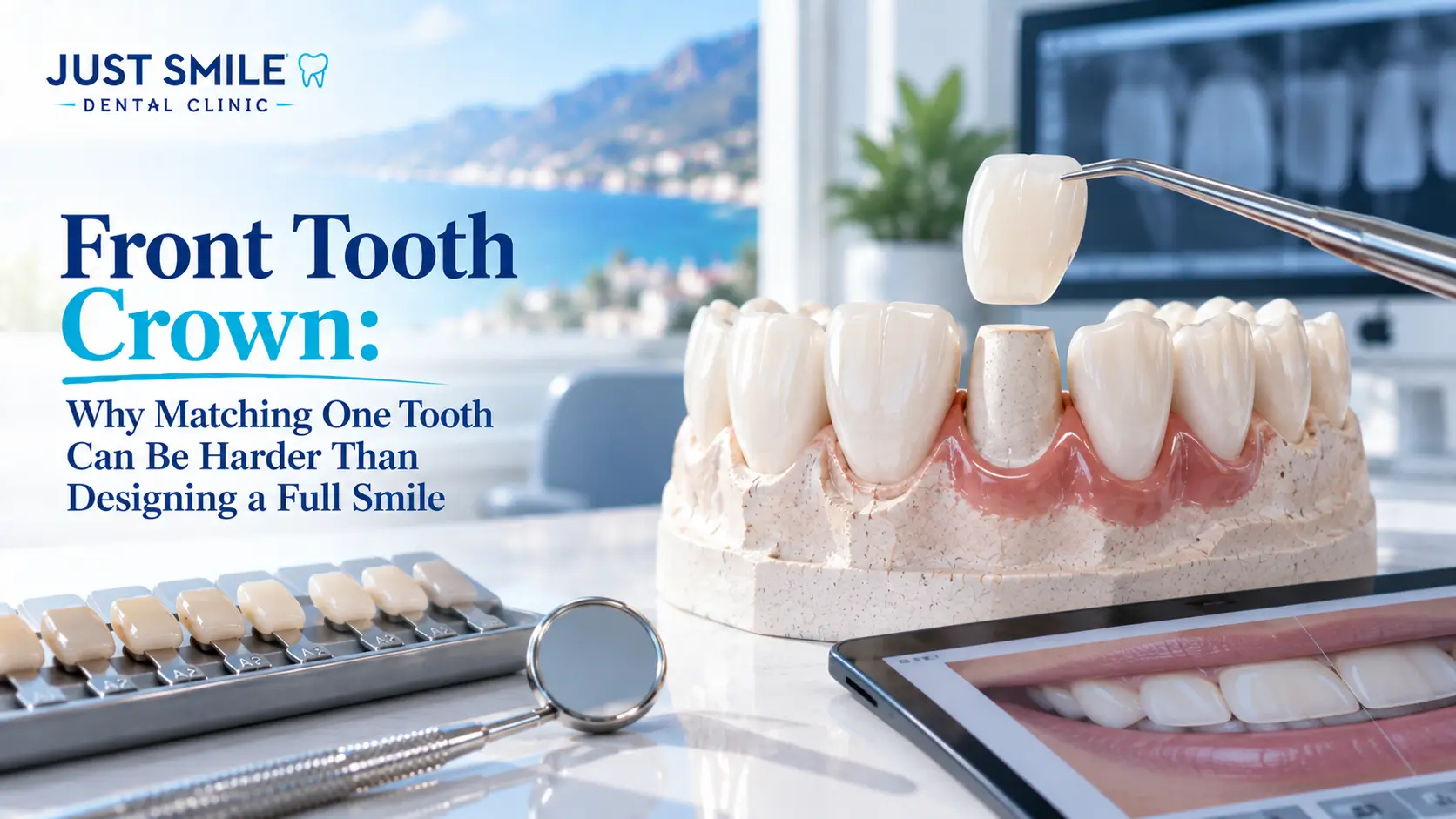
Front Tooth Crown: Why Matching One Tooth Can Be Harder Than Designing a Full Smile
Quick Answer
A front tooth crown can be particularly demanding because it must blend with natural teeth that are not changing.
At Just Smile Dental Clinic in Antalya, Turkey, the dentist and dental technician need to consider more than a shade code. Brightness, translucency, underlying tooth colour, surface texture, tooth shape, gum position and the characteristics of the neighbouring teeth can all influence whether the crown looks naturally integrated or obviously restored.
When several front teeth are designed together, these details can be coordinated across the group. With a single front tooth crown, the surrounding natural teeth have already set the reference.
Why Is a Front Tooth Crown So Difficult to Match?
Imagine replacing one upper central incisor.
Immediately beside it is another natural central incisor.
That neighbouring tooth becomes a direct comparison for almost everything:
- Length
- Width
- Brightness
- Shape
- Surface texture
- Translucency
- Gum position
- Incisal edge
- Light reflection
Even a relatively small difference can become noticeable because the two teeth sit side by side.
The objective is therefore not simply to create an attractive crown.
It is to create a crown that belongs beside the natural tooth next to it.
A Natural Front Tooth Is Not One Shade
One reason front tooth crowns can look artificial is that natural teeth do not have one uniform colour from top to bottom.
At Just Smile Dental Clinic in Antalya, Turkey, our dentist and dental technician consider the natural variations within the tooth when planning a front tooth crown. The area near the gum may appear warmer or more saturated, while the centre of the tooth can look brighter and the incisal edge may be more translucent.
Small internal variations can also become visible under different lighting conditions, which is why careful shade and characterisation are important for creating a natural-looking crown.
Dental colour is commonly considered through several dimensions:
Value describes how light or dark the tooth appears.
Chroma describes the intensity of the colour.
Hue describes the general colour family.
But even these measurements do not fully describe the optical character of a natural tooth.
This is why selecting something like “A1” is only the beginning of shade communication rather than a complete design instruction.
Why Brightness Can Matter More Than the Shade Name
Two teeth can appear to belong to approximately the same shade family but still look different when placed side by side.
At Just Smile Dental Clinic in Antalya, Turkey, the difference people notice first may be value — the relative lightness or brightness of the restoration. If a front tooth crown is slightly too bright, it can draw attention immediately. If it is too dark, the same can happen for the opposite reason.
Successful shade matching therefore depends on how the complete restoration behaves beside the natural tooth, not simply whether both carry the same shade-guide label.
The Tooth Under the Crown Can Affect the Final Appearance
A crown does not exist independently from what lies beneath it.
The underlying tooth may be:
- Naturally coloured
- Heavily discoloured
- Previously root-canal treated
- Built up with restorative material
- Supported by an implant abutment rather than a natural tooth
These backgrounds can create different optical challenges.
A darker underlying tooth structure, for example, may require greater masking ability. However, simply making the crown completely opaque can create another problem: the restoration may lose the depth and light behaviour that help natural teeth appear lifelike.
At Just Smile Dental Clinic in Antalya, Turkey, this creates a careful balance between masking what should not show through and preserving enough optical depth and translucency to avoid a flat, artificial-looking result.
Translucency Makes Natural Teeth Look Different From Solid White Objects
Natural enamel transmits and reflects light.
That interaction contributes to the visual depth of a tooth.
This matters especially at the front of the mouth.
A crown that is too opaque can look dense or flat.
A crown with inappropriate translucency may allow too much underlying colour to influence the final result.
The correct balance depends on the individual tooth, material, preparation and neighbouring teeth.
There is no universal opacity level that makes every front tooth crown look natural.
Shape Can Reveal a Crown Even When the Colour Is Correct
Colour receives most of the attention, but shape is equally important.
A central incisor has characteristic:
- Width-to-length relationships
- Line angles
- Curvature
- Contact areas
- Incisal edge shape
- Surface contours
Changing one of these details can alter how large or small a tooth appears. For example, moving the visible line angles inward can make a tooth appear narrower without dramatically changing its actual dimensions.
At Just Smile Dental Clinic in Antalya, Turkey, this is particularly important when reproducing a single front tooth, because the corresponding natural tooth on the other side of the smile provides a direct reference.
The crown should not simply look like a generic central incisor. It should look like it belongs naturally to this particular smile.
Perfect Symmetry Can Sometimes Look Less Natural
It might seem logical to mirror the opposite front tooth perfectly.
Natural mouths rarely work that way.
The two central incisors can contain subtle differences in:
- Edge position
- Rotation
- Surface character
- Gum height
- Shape
- Wear
A convincing front tooth crown therefore needs harmony more than mathematical duplication.
Surface Texture Changes the Way Light Hits the Crown
A natural tooth may look smooth at first glance, but enamel contains subtle surface detail.
Small vertical and horizontal features change how light reflects from different areas of the tooth.
This explains a situation that can otherwise seem confusing:
A crown may technically have a similar colour to the tooth beside it but still look brighter.
The problem may not be the shade itself.
The restoration may be reflecting light differently because its surface is smoother, glossier or shaped differently.
For a single front tooth, those details matter.
Why the Incisal Edge Needs Special Attention
The biting edge of a natural front tooth is rarely just a straight strip of white material.
Depending on the individual tooth, it can contain subtle:
- Translucent zones
- Areas of different opacity
- Internal character
- Wear
- Small irregularities
Reproducing these natural details can make the difference between a restoration that looks manufactured and one that blends naturally into the smile.
At Just Smile Dental Clinic in Antalya, Turkey, the goal is not to add artificial-looking effects simply for the sake of complexity. It is to observe what the neighbouring natural teeth actually contain and reproduce only the characteristics that are relevant to creating a harmonious, natural-looking result.
Can Technology Help Match a Front Tooth Crown?
Yes, particularly for colour communication.
Traditional shade guides rely partly on human perception, which can be influenced by lighting, surroundings and observer differences.
Digital shade-analysis systems and spectrophotometers can provide additional information about tooth colour.
But technology does not replace clinical judgement.
A device can provide colour data.
It does not independently decide:
- Tooth shape
- Surface anatomy
- Gum relationship
- Incisal character
- Facial integration
The strongest approach combines objective information with clinical observation, photography and laboratory communication.
Why the Material Choice Matters
Different ceramic systems offer different combinations of strength, opacity and translucency. The material therefore needs to suit both the structural requirements of the tooth and the aesthetic demands of the case.
At Just Smile Dental Clinic in Antalya, Turkey, our crown workflow uses modern restorative materials and digital techniques, including clinical examination, digital scanning, temporary restorations and final bite assessment.
However, material choice should always be individual, based on the condition of the tooth, functional requirements and the desired aesthetic result.
A severely discoloured underlying tooth may create different optical requirements from a normally coloured prepared tooth.
The question is not simply:
“Which material is best?”
It is:
“Which combination of material properties works for this tooth?”
Why One Crown Can Be Harder Than Designing Several
When several neighbouring restorations are created together, the dentist has control over much of the visible composition.
With one crown, most of that composition already exists.
| Several Front Restorations | One Front Tooth Crown |
| Overall shade can be selected together | Must match existing natural teeth |
| Tooth shapes can be coordinated | Must reproduce established anatomy |
| Texture can be designed across the group | Must blend with natural enamel |
| Brightness can be balanced together | Existing tooth determines the target |
| Incisal character can be coordinated | Must reproduce neighbouring details |
| Symmetry can be adjusted across several teeth | Small discrepancies are immediately visible |
This does not mean more natural teeth should be crowned simply because it makes matching easier.
Healthy teeth should not receive unnecessary irreversible work for laboratory convenience.
It means a single front tooth crown deserves particularly careful planning.
How JST Approaches a Front Tooth Crown
At JST Dental, a front tooth crown is planned as part of the full smile rather than as an isolated restoration.
The clinical team considers:
How does the opposite front tooth reflect light?
Where is it translucent?
What makes its shape individual?
Does the prepared tooth need masking?
How does the gum frame each central incisor?
Does the crown look natural from conversational distance as well as close up?
The crown should be assessed as part of the face and smile rather than as an isolated ceramic object.
Frequently Asked Questions
Can you put a crown on one front tooth?
Yes. A single front tooth can receive a crown when full coverage is clinically appropriate. At Just Smile Dental Clinic in Antalya, Turkey, the aesthetic challenge is matching the crown closely with the untreated natural teeth beside it, including their colour, translucency, shape and surface characteristics.
Will a front tooth crown look natural?
A carefully planned crown can closely integrate with natural teeth, but the result depends on factors including the underlying tooth, ceramic properties, shade communication, shape and surface character.
Why does my crown look whiter than my natural tooth?
Differences in brightness, translucency, surface gloss or shade can all make a crown appear lighter. A crown may therefore look different even when its basic shade designation appears similar.
Is zirconia suitable for a front tooth crown?
Zirconia can be used for visible anterior crowns, but the specific material and design should reflect the tooth’s structural and aesthetic requirements.
Why is matching one front tooth so difficult?
The crown is compared directly with natural enamel beside it, so small differences in brightness, anatomy, translucency and texture become easier to notice.
A Good Front Tooth Crown Should Stop Drawing Attention
The objective of a front tooth crown is not to create the brightest, smoothest or most perfectly shaped tooth in the smile. Quite often, those characteristics are exactly what can make a restoration noticeable.
The real challenge is reproduction. The crown needs to respond to light like the natural teeth around it, fit the proportions of the smile and contain enough natural variation to avoid looking manufactured.
At Just Smile Dental Clinic in Antalya, Turkey, this means designing the restoration around the neighbouring teeth rather than asking the neighbouring teeth to fit the crown.
When only one front tooth is being restored, success can be surprisingly simple to describe:
You should eventually stop noticing which tooth was the difficult one.